Delhi, Undisturbed
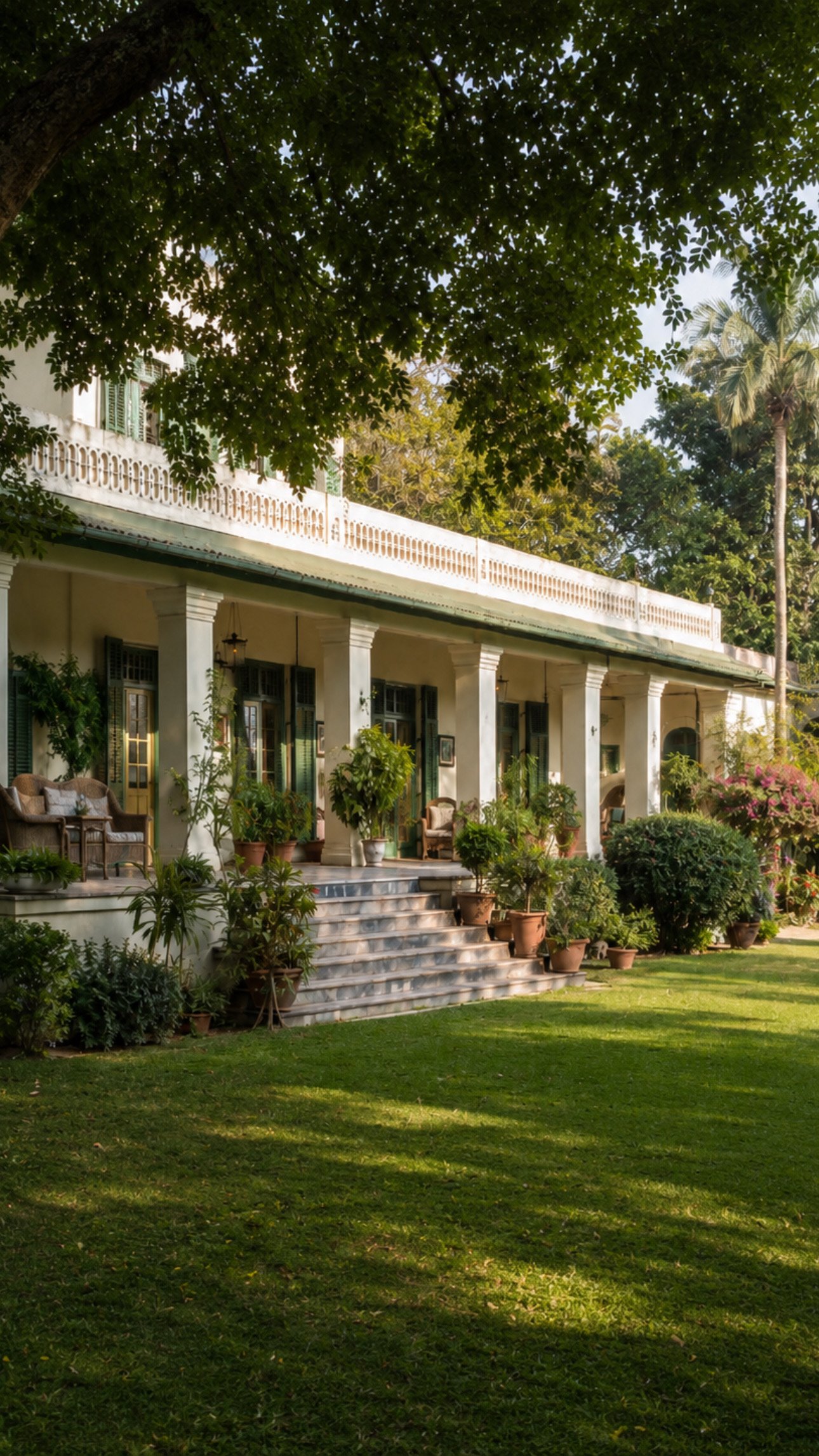
Pots added one at a time, moved for the season, replaced when they died. Fifty years of small decisions, none of them design.
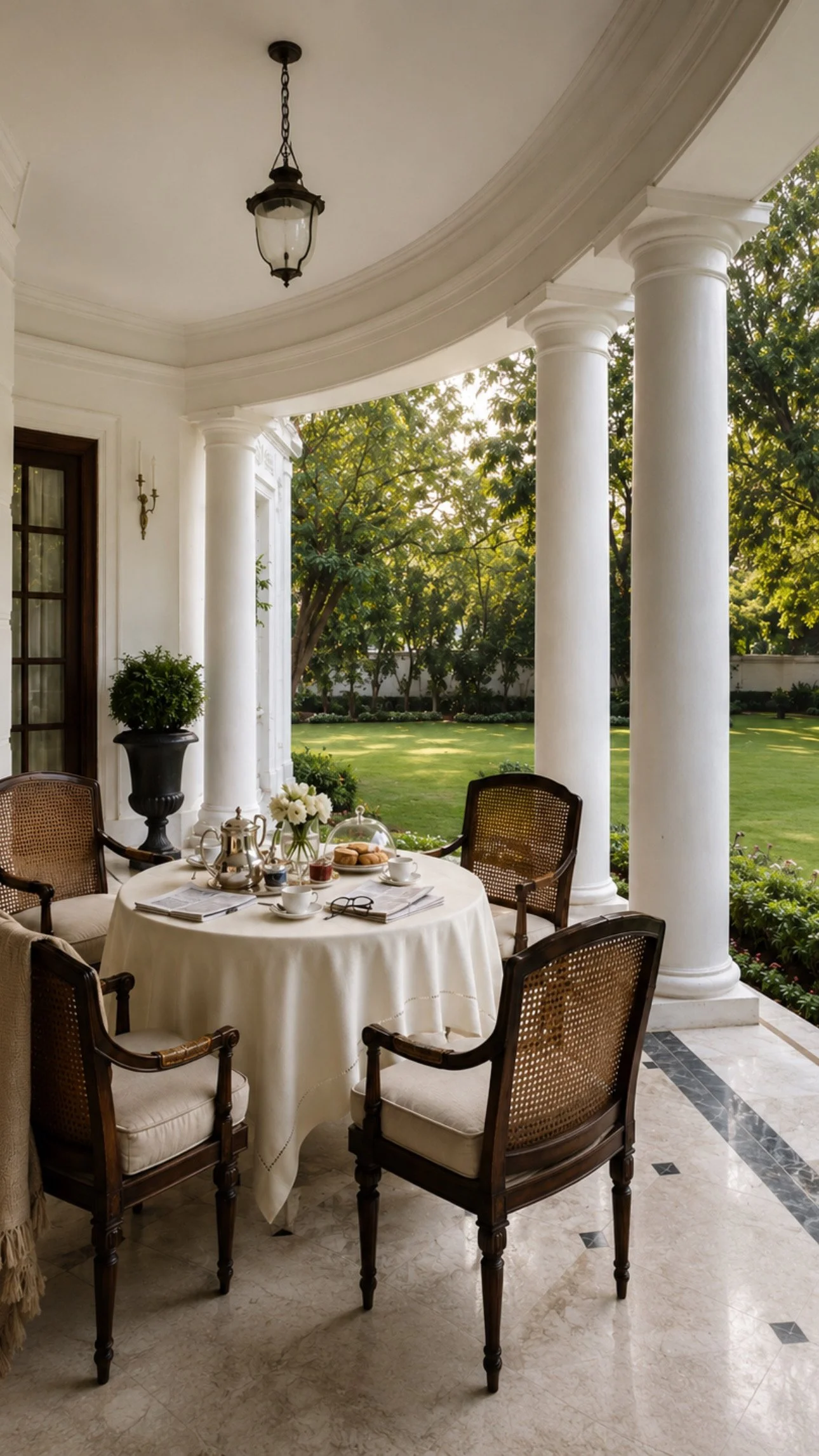
Composed, and worth admitting. A photograph cannot tell a household that entertains from one that wants to look like it does.
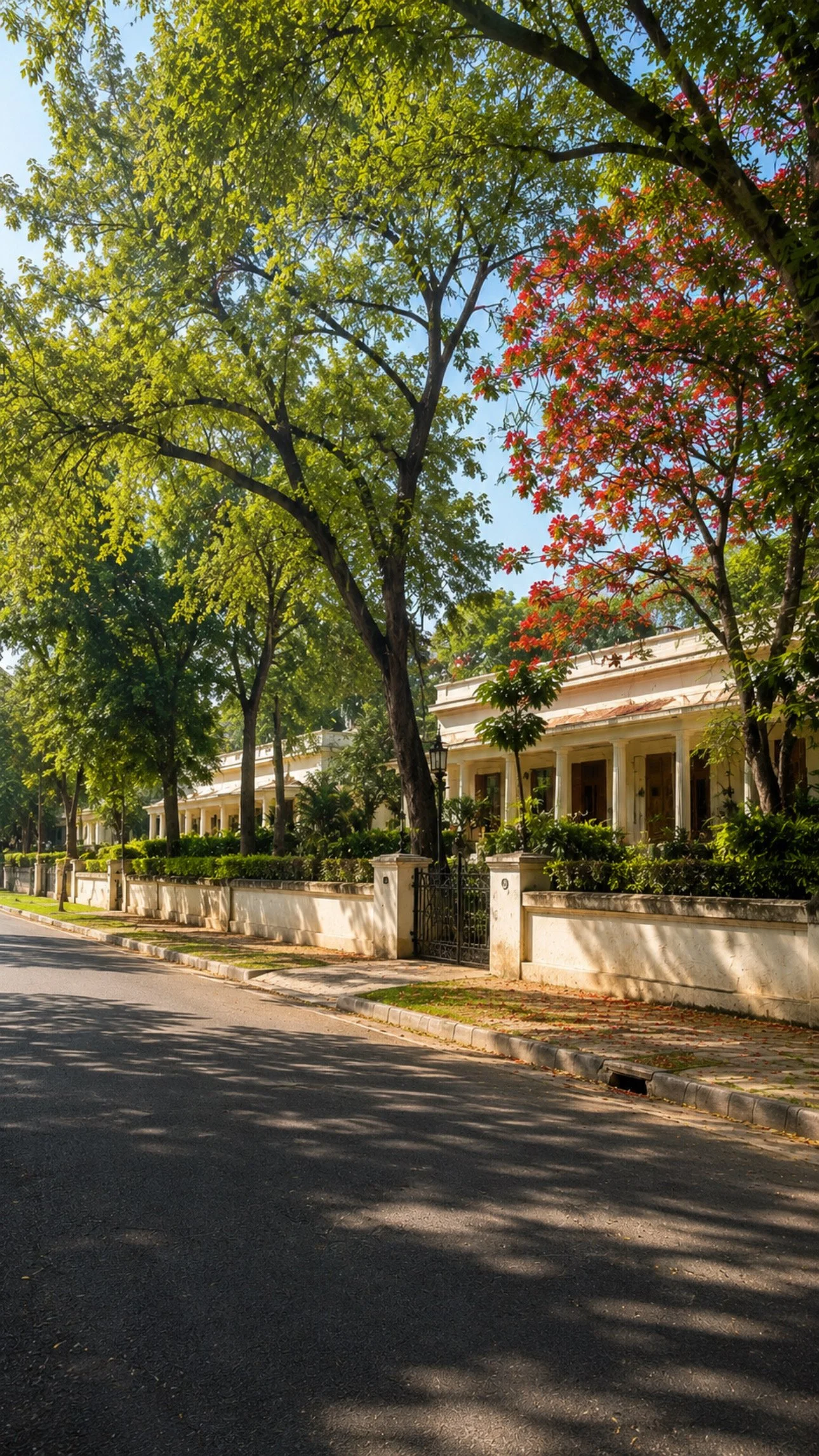
The gulmohar is municipal. Nobody behind these walls chose the best thing about the street.
On restraint, discretion and the things time cannot manufacture
The Shop That Does Not Need to Sell
The dealer does not look up.
This is Sunder Nagar on a weekday afternoon, in a shop with brass in the window and a display case that no longer closes perfectly. Some objects are valuable enough that another kind of shop might place them under theatrical lighting and attach a carefully designed card.
Here, there are no visible prices.
Tea arrives in a glass. Questions are answered plainly. Nothing appears arranged to accelerate a decision.
Nobody is being hurried into wanting anything.
A few kilometres away, the same visual vocabulary exists in a far more finished form: stone, subdued lighting, fine textiles, restrained furniture, objects without conspicuous branding, service calibrated to appear and disappear almost without friction.
It can be beautifully executed.
It is also reproducible.
That distinction matters because understatement has become one of the most sophisticated products of contemporary luxury. Entire industries now manufacture the appearance of having removed excess: invisible logos, muted palettes, unmarked entrances, natural materials, handmade irregularities, objects selected to appear collected rather than purchased together.
Quiet has become something that can be commissioned.
Delhi presents a more complicated proposition because some of its quietest environments were never trying to become quiet in the first place.
Houses: Designed Restraint and Accumulated Time
Consider two houses on comparable pieces of central Delhi.
The first has a low whitewashed wall, marked where years of monsoon rain have travelled down it. Chiks hang across the veranda, slightly uneven because things have been repaired and replaced as required rather than renewed simultaneously.
Terracotta pots have accumulated gradually: a fern here, a palm there, another shifted because one corner receives less summer sun.
There is a number beside the gate and a single practical light near the entrance.
Nothing appears unfinished.
Nor does anything appear especially composed.
The second house is more resolved. Stone meets ironwork cleanly. Bougainvillea has been trained along the boundary. Lamps correspond. Paving follows a deliberate pattern. Architectural elements repeat with enough precision that the intention behind them is immediately visible.
Both houses may be exceptionally valuable.
Both may be comfortable.
Both may be beautiful.
But they communicate differently.
Behind them stands the same gulmohar.
When it flowers, orange falls across walls, gates and road alike. The tree predates most current decisions about either property. It was not selected to complement the architecture, commissioned to complete a scheme or positioned to improve a photograph.
It simply grew there.
And somehow it becomes the most memorable element in the street.
That is the distinction.
Some things are designed.
Others accumulate.
Comfort Can Be Engineered. Continuity Cannot.
A mattress can be specified. Water pressure can be engineered. Temperature can be controlled. Acoustic performance can be measured. A lift can arrive before impatience begins.
Modern hospitality and residential design have become extraordinarily good at removing friction.
That is not superficial work. Doing it well requires knowledge, investment and discipline.
But another form of comfort develops differently.
A gardener learns where one corner burns in May. A room acquires a particular smell after decades of monsoon, timber, books and winter sunlight. A chair remains beside a window because moving it has never seemed necessary. A veranda develops its own rhythm of shade.
None of these things necessarily improves a building in measurable terms.
They give it continuity.
Contemporary luxury often attempts to reproduce the visible surface of this condition.
Sometimes very successfully.
But intention remains visible.
Restraint can be designed. Discretion is something else.
Discretion is not the absence of beauty or expenditure. Nor does it belong exclusively to old houses, inherited institutions or old money.
It is simply the absence of a requirement that everything communicate.
Central Delhi: Scarcity That Was Not Entirely Designed
In winter, fog can hold above central Delhi until mid-morning. Around Raisina Hill and the bungalow districts beyond it, avenues remain disproportionately wide, their edges softened by mature trees.
Behind compound walls there may be little more to hear than birds, water and an occasional gate.
Much of this landscape originated not as contemporary luxury housing but as administrative infrastructure during the construction of New Delhi.
That history matters.
The exceptional desirability of the area today was not the original brief.
Space, distance, setbacks and avenues belonged to another urban order. Later controls on redevelopment preserved many of the conditions that a more intensive real-estate market might otherwise have compressed.
Its scarcity was therefore not entirely designed as scarcity.
That accidental quality remains part of its character.
Golf Links follows another pattern. Jor Bagh remains unusually residential despite its position. Malcha Marg still retains something of the practical character of a local market despite the value of the property surrounding it.
Civil Lines preserves a different inheritance again: deeper verandas, older trees and buildings belonging to an earlier Delhi.
These neighbourhoods are not significant because they conform to one aesthetic.
Their character lies partly in what has survived.
Newness Is Not Inferiority
Gurgaon demonstrates the opposite proposition exceptionally well.
Its finest residential towers can offer extraordinary contemporary comfort: filtered air, controlled access, high-performance glazing, efficient maintenance, dependable infrastructure and integrated services.
For many residents, that is not a compromise.
It is precisely the attraction.
An old bungalow can demand continuous attention. A new tower can remove an entire category of domestic uncertainty.
What the newer building cannot possess immediately is residue.
It has not existed long enough.
That is not criticism.
Age itself guarantees nothing. An old house can become lifeless. Inherited furniture can carry no meaning. Tradition can continue long after anyone remembers its purpose.
Continuity matters only when life continues through it.
Delhi Has More Than One Language of Permanence
Punjabi Bagh demonstrates why visual restraint is an unreliable measure of discretion.
Its residential culture emerged from a very different history from central Delhi. Many families rebuilt livelihoods after Partition through trade, manufacturing, distribution and property. Houses often developed around large families, gatherings and visible hospitality.
Marble façades, expansive entrances and generous celebrations belong to another aesthetic vocabulary.
They are not necessarily attempts to imitate the centre.
One part of Delhi developed through colonial administrative planning. Another through migration, rebuilding, enterprise and family expansion.
Both produced their own forms of permanence.
The difference is not necessarily between discretion and display.
Often it is simply between different ideas of what a house is supposed to do.
Institutions: Continuity Without Romanticism
Institutions reveal the same tension.
The Delhi Gymkhana carries the physical evidence of long use: corridors repeatedly repainted, notice boards, old furniture, thick cups, rooms adjusted incrementally rather than reconceived every decade.
None of this should be romanticised merely because it is old.
Institutions are not made admirable by worn paint, and continuity is not a substitute for sound governance.
Heritage and institutional quality are separate questions.
The India International Centre offers another kind of continuity.
Its character does not depend primarily on material luxury. The architecture is restrained. Furniture is functional. Coffee remains coffee rather than becoming a performance around coffee.
Its atmosphere comes from repeated use: lectures, conversations, exhibitions, book launches, music, lawns and corridors.
Nothing needs to be exaggerated for the place to possess identity.
The identity has accumulated.
Time Is the Part That Cannot Be Ordered
This quality attaches just as easily to inexpensive things as expensive ones.
A chair becomes familiar through use.
A tree becomes important because generations have crossed beneath it.
A shop becomes part of a neighbourhood because the same shutter has opened for decades.
A room develops atmosphere because enough unrelated lives have passed through it.
None of these require luxury.
They require duration.
Money can purchase exceptional materials, privacy, architecture and service.
It can accelerate craftsmanship.
It can preserve what already exists.
It can even reproduce the visible language of age.
What it cannot purchase is elapsed time.
Hospitality: The Value of Knowing When Not to Intervene
Hospitality reveals the distinction particularly clearly.
Sophisticated service is often visible in timing: when someone approaches and when they do not; when a question is useful and when silence is better; when assistance becomes attention and when attention becomes intrusion.
Much of good service can and should be trained.
Standards matter.
Technique matters.
Systems matter.
Yet the finest service often contains knowledge that exists beneath procedure — an understanding produced through repetition, memory and familiarity with human behaviour.
The distinction resembles the houses.
Some things can be briefed. Others emerge from having done the same work carefully for a very long time.
Exclusivity Is Temporary. Context Is Harder to Reproduce.
Most forms of exclusivity eventually become accessible in some form.
A product can be purchased.
A design language can be learned.
A neighbourhood can change.
An institution can admit new generations.
Cities absorb newcomers, alter themselves around them and eventually forget who arrived first.
That process is not the failure of a city.
It is how a city remains alive.
What is harder to reproduce is accumulated context.
Delhi Golf Club: Centuries on the Same Ground
At the centre of Delhi, a golf course passes between medieval remains.
The present landscape belongs simultaneously to sport, archaeology and a modern metropolis.
On a winter morning, golfers move past tombs belonging to an entirely different Delhi. Peacocks cross the rough. Traffic exists only a short distance away.
Several centuries occupy the same piece of ground without resolving themselves into a single story.
Among the structures is Lal Bangla, a red sandstone monument associated with burials whose identities have long attracted differing historical interpretations.
The uncertainty itself feels appropriate.
Delhi is filled with places whose present significance is clearer than the identities of the people for whom they were originally built.
Power leaves architecture behind more reliably than it leaves memory.
Courts disappear.
Administrations change.
Land changes function.
Private houses become institutions. Roads acquire traffic their planners never imagined. Trees planted for shade become more valuable to neighbourhoods than many of the buildings constructed beneath them.
Everything begins as somebody's present.
Eventually it becomes context.
What Cannot Be Manufactured
That may be the real difference between designed quiet and accumulated discretion.
One can be produced immediately.
The other depends on things surviving long enough to stop explaining themselves.
A stained wall.
A chik bleached unevenly by the sun.
A neighbourhood shop whose display has barely changed.
A tomb beside a fairway.
A gulmohar planted by someone whose name nobody remembers.
And back in Sunder Nagar, the dealer still does not need to create an atmosphere.
The room has already had one for decades.
Quiet can be designed.
Discretion begins when nobody feels compelled to point it out.
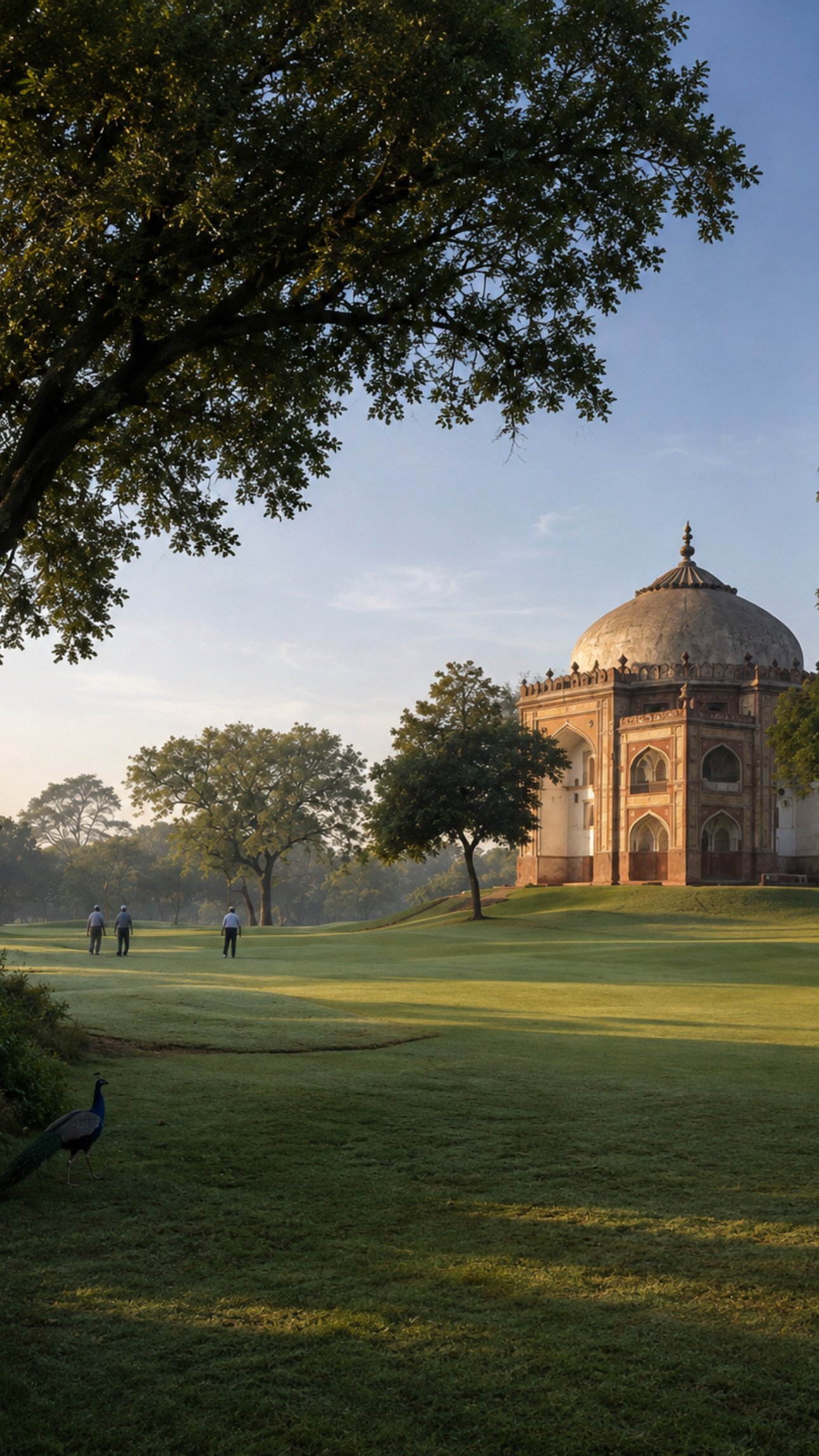
The course was routed around the tombs. The peacocks are residents; the players are members.
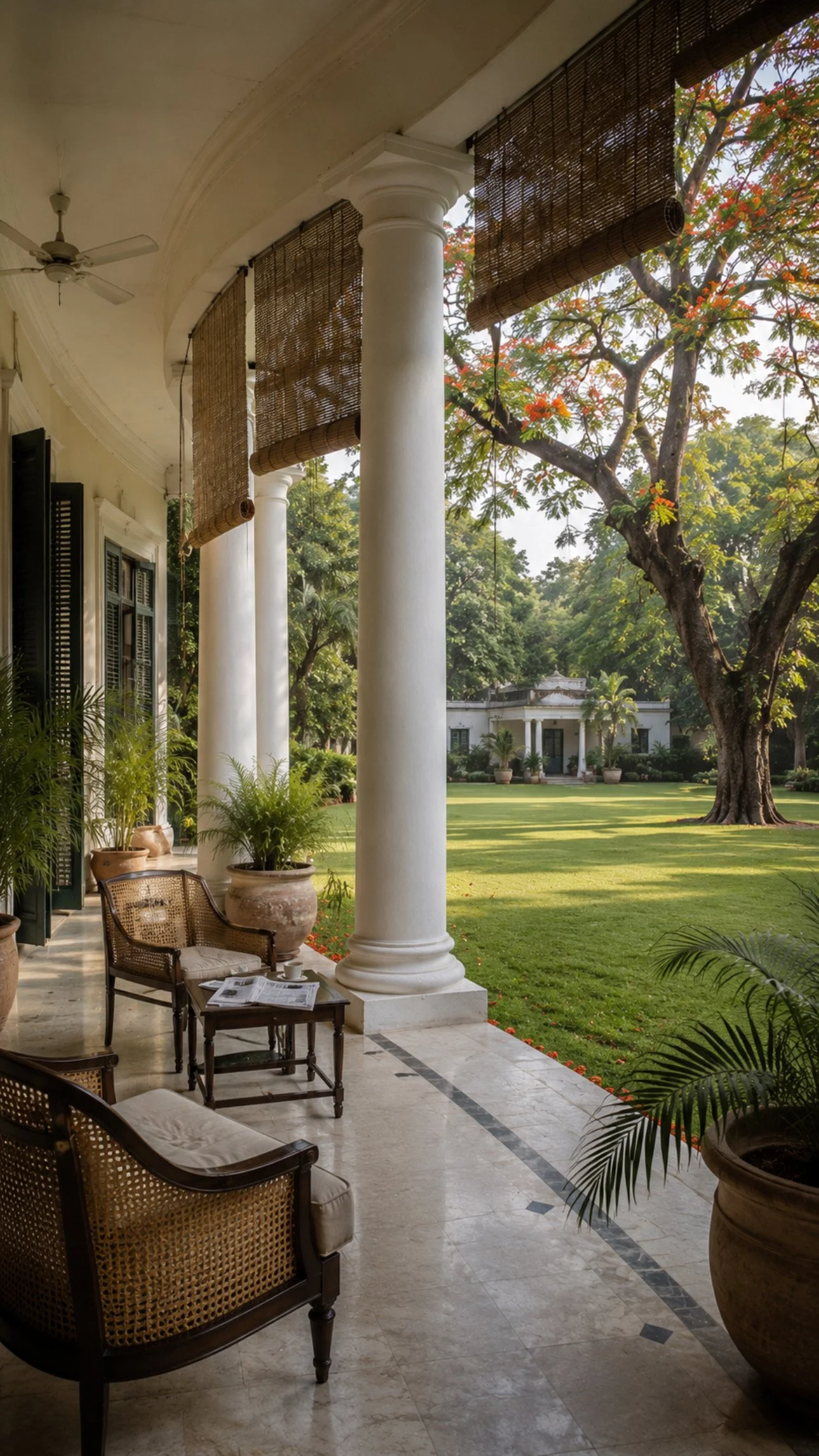
Chiks rolled to different heights, adjusted through the day by someone who knows when the sun turns.
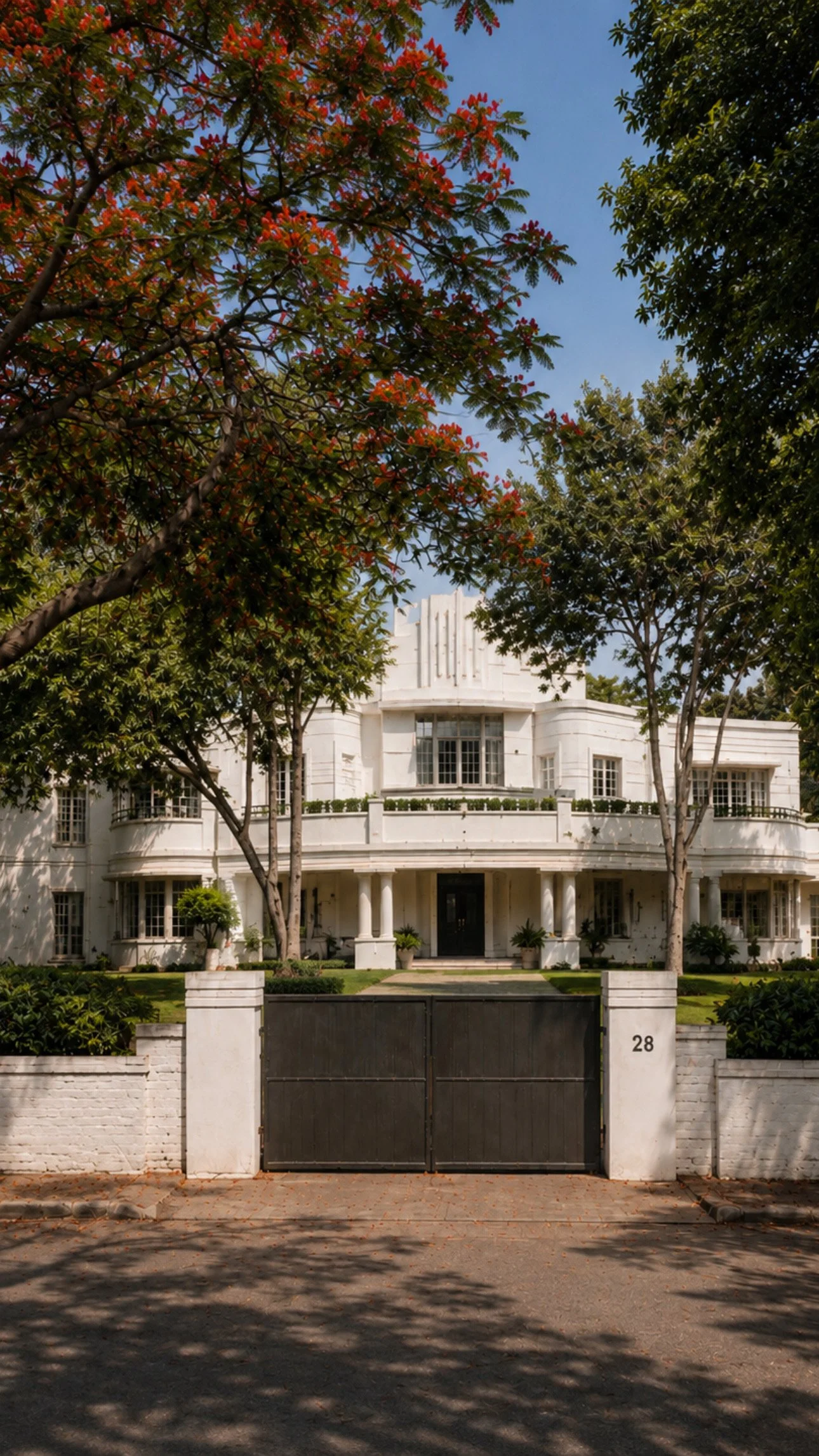
No. 28. Low wall, no name, only the number.
