Someone Has to Keep the Quiet
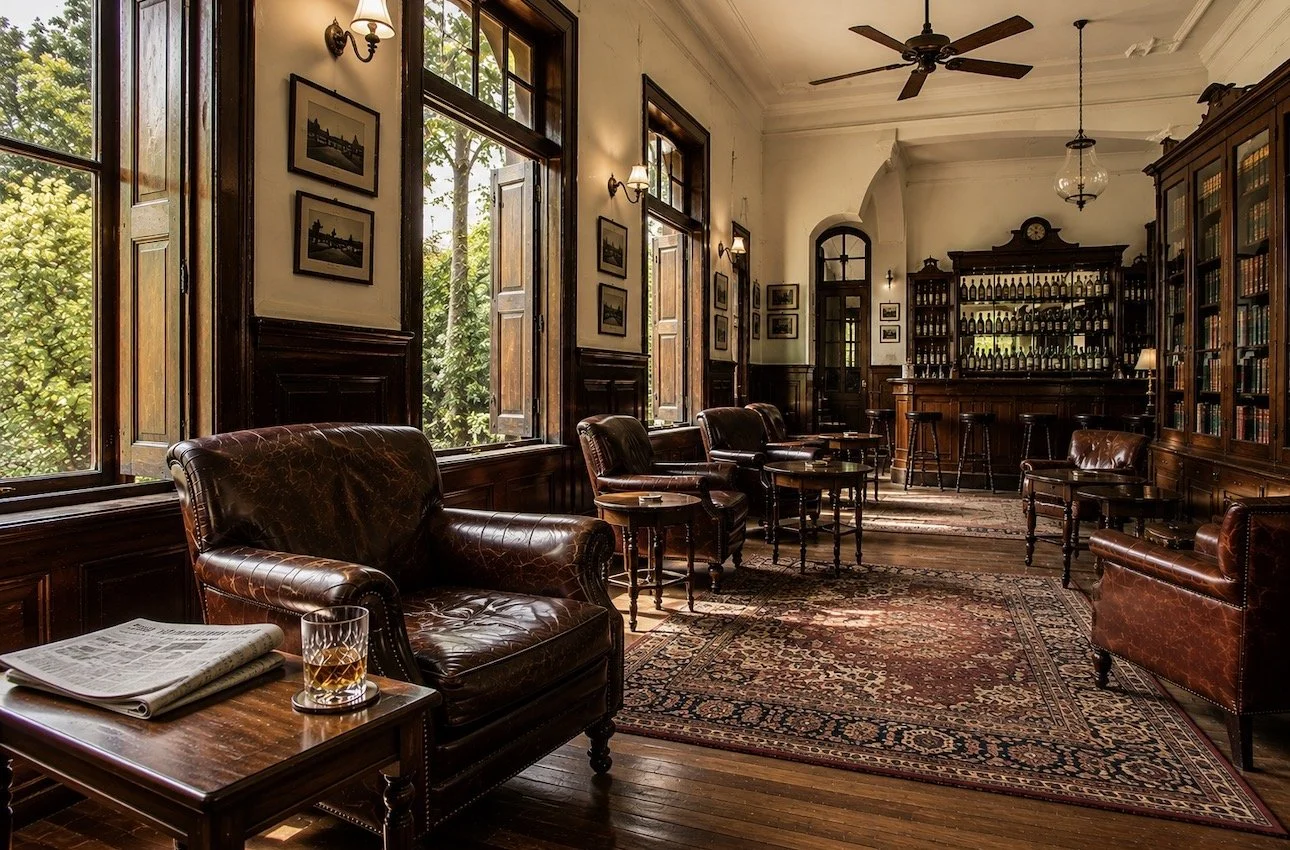
The room asks very little of you. That is part of its hospitality. An afternoon with nowhere else to be.
India’s members’ clubs are usually written about for who is inside them. This is about the afternoons: verandahs, ceiling fans, unread books, and the particular hospitality of being left alone, in rooms where almost nothing is scheduled to happen.
There is a moment, just past the gate, when the sound drops.
Not gradually.
All at once.
The horns are still there. They have simply moved behind you, to a distance that no longer concerns you. The car slows because the drive is long and nobody is in a hurry at this end of it. Trees close over the road. Then the road opens, and there is grass.
A great deal of grass.
In a country where land is the most argued-over thing there is, here are several acres of it doing nothing at all except being green.
Two riders are crossing the far side. Nobody is watching them, which is somehow the point.
The Green That Nobody Is Using
The first luxury is not the building. It is the emptiness in front of it.
Anyone who has lived in an Indian city understands what it costs to leave a space unfilled. Every square metre is under pressure. Something wants to be built there, parked there, sold there, slept on. Emptiness is not a natural condition. It is a decision, renewed daily, usually against considerable financial argument.
So when you sit on a verandah and look at a maintained green with almost nobody on it, you are not looking at grass.
You are looking at a refusal.
Someone was up at half past five cutting it. The stillness you are enjoying at four in the afternoon has a work roster behind it.
What the Rooms Smell Like
Inside, the first thing is floor polish.
Then old paper, which is the bookcases at the far end, glass-fronted, full of bound volumes that nobody has taken down in years and everybody would object to losing.
Then, faintly, cut grass, coming in through the shutters.
The corridor is long and dim and hung with photographs of the same building in earlier decades, in which the trees are smaller and the men are wearing more clothes. There is a notice board. The notices are typed. They concern the tennis ladder, a change to the timing of Sunday lunch, and a reminder about mobile telephones in the dining room, which is worded politely and enforced absolutely.
From somewhere, the click of a billiard ball, then the second click.
From somewhere else, cutlery being laid for a lunch that is still two hours away.
The floorboards give slightly. The carpet has gone pale in a line down the middle, because for eighty years people have walked to the bar the same way.
Nobody has fixed this.
That is the whole atmosphere, really. A great many things here could be improved and have been left alone instead.
A Chair That Has Been Sat In
There is a chair by the window. Leather, dark, cracked across the seat in the way leather cracks when it has held the same weight in roughly the same place for thirty years. The arms are worn paler than the back.
Nobody would call it beautiful. It is shaped.
A newspaper lies folded on the low table beside it. A glass, half finished, on a small brass coaster. Above the bar, a clock that is slightly wrong and has been for as long as anyone can remember. The ceiling fan turns at a speed suggesting it has never been in a hurry and does not intend to start.
Nothing in this arrangement is new. Nothing in it is being improved.
That is rarer than it sounds. Most rooms we enter are in the middle of becoming something else. They are being refreshed, repositioned, brought up to date. There is a plan for them.
This room has no plan. It reached its conclusion some time ago and has been left alone since.
Time.
That is what you are actually sitting in.
The Bill That Never Arrives
In many of these clubs, you will not see a price all afternoon.
The drinks come, the lunch comes, and at the end a small printed slip arrives and you sign it. No card, no cash, no total announced at the table, no folder placed at your elbow at the moment the conversation was going well.
It is settled later, monthly, elsewhere, by somebody in an office you will never visit.
It is a small mechanical detail and it changes the temperature of the room. Few other places let you sit for four hours without money entering the conversation. In a restaurant, however good, there is a transaction waiting at the end of the evening, and part of you is aware of it from the first course onward.
Here the transaction happened years ago, when you joined, and has never come up again.
You are not a customer. That is the feeling, and it is difficult to buy.
Together, Separately
Three men are at the bar, talking. One man is at the window, reading, and will not be spoken to.
Everyone understands this. It required no announcement.
The reader is not hiding. He is in full view, in a public room, twelve feet from a conversation. He is simply, visibly, not available. And the room has agreed.
Later, one of the men at the bar will pass behind his chair on the way out. There will be a nod. Half a second. No words, no stopping, no enquiry after the family.
The nod says: I know who you are, I am glad you are here, and I am not going to do anything about it.
There is a whole theory of hospitality inside that half second.
We have been taught to measure service by how much of it there is. How quickly someone arrives. How warmly you are greeted. How many times the water is refilled. By that measure, a room where nobody approaches you is a failure of service.
By another measure, it is the highest form of it.
To be recognised without being addressed is a very specific comfort. You have been seen. You have not been claimed. You may sit there for two hours with a newspaper and a drink and produce nothing, explain nothing, and be nobody in particular, and the room will hold that for you without asking what it is for.
Most people cannot do this at home. There is someone to attend to. Somebody wants something.
Not here.
The Long Middle of the Afternoon
The room has hours, and they are not the same.
At noon it belongs to lunch and to people with somewhere to be afterwards. There is a certain amount of laughter from the dining room.
By three it has emptied almost completely, and this is the best of it. Four men in a building meant for four hundred. Light coming flat through the shutters and moving very slowly across the floor. The bar not yet open, or open with nobody at it. A waiter standing near the doorway doing nothing in particular, at ease, not pretending to be busy.
By six the sound comes up again. Ice. Chairs moving. Someone arriving from an office and taking twenty minutes to stop being a person from an office.
By eight the dining room is full and the verandah is empty and the fans are still going.
Nothing about this schedule is enforced. It simply happens, the same way, every day, and has for decades, which is why people who come here often can tell the time by the volume of the room without looking up.
The Work of Not Being Noticed
The second drink arrives without being ordered.
This is the moment people describe as magical, and it is not magic. It is memory, held by a person on a salary, over a period of years.
He knows what you drink. He knows you take it before six and not after. He knows that on the days you come in with the newspaper under your arm you want nothing at all for the first twenty minutes, and that on the days you come in without it you would probably like someone to say good evening properly.
There is no system that stores this. It lives in one man’s head, and in the head of the man who trained him, and it will leave the building when he does.
Many of these men have been in the same rooms for twenty-five and thirty years. Longer than most of the members’ marriages. Longer than the careers that paid for the memberships.
It would be dishonest to describe this warmly and stop there. These rooms were built on a hierarchy, and a version of it is still standing. The peace of the man in the chair rests on the attention of a man who will not sit in it. That is not a small thing and it should not be smoothed over with the word tradition.
But it is also true that knowing when not to approach a table is a genuine skill, rarely written into any job description, almost never trained for, and mostly invisible when it is done well. It is only visible when it fails, when someone hovers, when someone interrupts, when someone asks whether everything is to your satisfaction for the third time and takes the afternoon apart.
Sometimes the most attentive thing in the room is the person who has decided to stay where they are.
A Country of Club Rooms
The atmosphere changes as the country does.
Mumbai moves, all day, at you, and the exhaustion it produces is physical. Its rooms are a wall against that: the Bombay Gymkhana on the maidan, the Willingdon behind its hedge, the Royal Bombay Yacht Club looking out at the water it was named for, the Cricket Club of India.
Delhi expands. Not so much fast as endless, and what it takes from you is a sense of proportion. The Delhi Gymkhana answers with lawns and distance and a great deal of white.
Kolkata remembers, and its rooms sit close together: the Bengal Club, the Calcutta Club, the Saturday Club, the Tollygunge Club across its hundred-acre grounds, the Royal Calcutta Turf Club and the Royal Calcutta Golf Club.
Chennai keeps its own time and declines to explain itself, at the Madras Club, the Madras Gymkhana and the Cosmopolitan Club.
Bengaluru remade itself at extraordinary speed, but the older city is still sitting quietly in the Bangalore Club, the Bowring Institute and the Century Club, on land the newer city would very much like to have.
Hyderabad and Secunderabad have the Secunderabad Club and the Nizam Club, one out of the cantonment, one out of the court. Pune has the Poona Club, the Deccan Gymkhana and the Royal Connaught Boat Club down on the river.
Then the land rises, and everything slows.
Mussoorie under mist.
Shimla when the temperature drops in the late afternoon.
Darjeeling, gone behind cloud for three days at a stretch, the Gymkhana Club somewhere inside it.
Shillong under rain. Dehradun beneath the hills. Chandigarh with its own post-Independence order and geometry. Each developed a different relationship with the idea of the club.
Ooty on a quiet morning. Wet grass, woodsmoke, the Ootacamund Club, the Wellington Gymkhana down the road, and a fire lit indoors in a month when the plains are unbearable.
The hill clubs feel different, and the difference is not architectural. In the plains, the room is a defence against the city. In the hills, the room is a continuation of the weather. You come in from the cold and the fire is the point. Nobody is escaping anything. They are sitting closer to the heat.
Where the Rooms Came From
None of this began innocently, and the atmosphere is not innocent either.
The Bengal Club was once described as the unofficial headquarters of the Raj. The Madras Club was founded for European men only. The Bangalore Club began life as a services club for officers of the British Empire. Indians, and later civilians, entered a room that had originally been created for neither.
These rooms were designed, precisely, to keep out the people who now sit in them.
Not all of them, though. Some were founded by Indians and Europeans together, precisely because the older clubs would not have them. Some of these rooms were built as arguments against the other rooms, while the empire was still standing.
Then the empire left, and the buildings stayed, because buildings do. The membership turned over. A second history began accumulating on top of the first, made of ordinary things. Somebody’s father’s usual table. A wedding whose photographs are now in somebody’s drawer. A cricket match nobody outside the club remembers. Forty years of the same man reading the same newspaper in the same chair.
A building can carry its history without requiring the people inside it to re-enact the society that built it.
And the older history has not been tidied away. The photographs are still in the corridor. The boards of past presidents have not been edited. Old ledgers and minute books survive too, carrying rules about who could come in and who could not.
Nothing has been corrected.
Not pride. Not apology. An accurate page, left open.
Look Who Is Here
Compare all this with the way luxury tends to announce itself now.
A new room opens. It is photographed before it is used. The lighting has been designed for cameras rather than for eyes, which is why so many are flattering in pictures and slightly unrestful in person. There is a concept, and often a story about the concept, printed and placed on the table where the salt should be.
None of this is contemptible. Considerable talent goes into it, and some of those rooms are wonderful.
But the transaction is different, and worth naming plainly.
One kind of room says: look who is here.
Another kind of room says: nobody here particularly cares who is looking.
The first offers you visibility. The second offers the opposite, and the opposite turns out to be harder to buy. Access can be sold overnight. Belonging cannot be manufactured at all; it can only be waited for. That is why people are willing to wait years for admission. The thing being rationed is not the building.
It is time.
You cannot pay to have been coming here for thirty years. You can only have been coming here for thirty years.
Which is perhaps why the best of these places never feel like destinations.
They feel like somewhere people come back to.
The Last Hour
The light goes early in the hills and slowly in the plains, but either way it goes, and the room adjusts without anybody adjusting it.
The fan continues. Somewhere behind the bar a glass is being wiped and set down. There is conversation in another room, at the volume conversation reaches when nobody in it is trying to be overheard.
The man by the window folds his newspaper along the crease it already has and puts it back on the table for whoever comes next.
He finishes his drink. He does not signal for another.
A waiter crosses, takes the glass, and does not replace it, because he understood the first part.
At the door, a nod.
Nothing happens. Nothing was supposed to happen. The whole afternoon was constructed so that nothing would need to.
Not silence, exactly.
Not privacy for its own sake.
Something quieter than either.
Somebody decided your afternoon was worth protecting, and then never mentioned it.
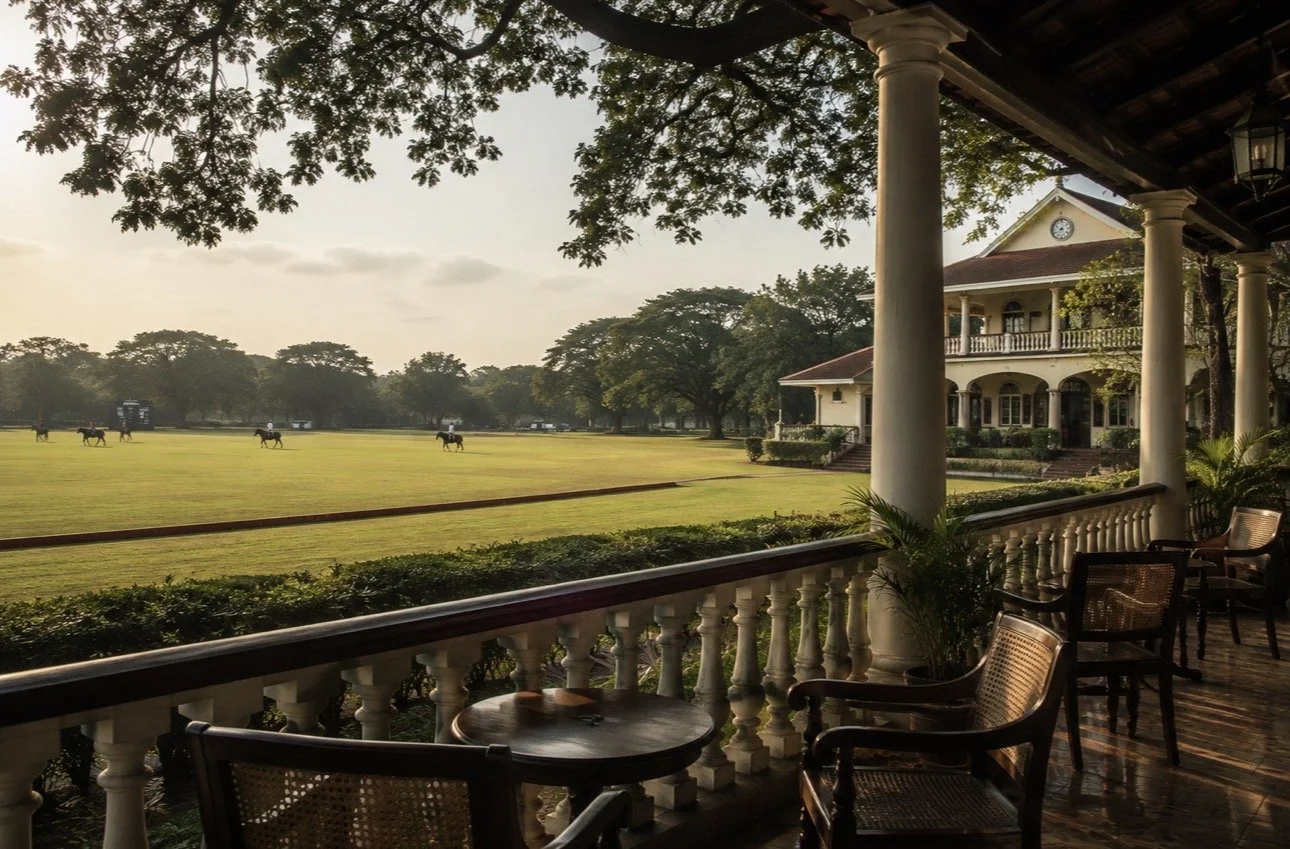
Beyond the verandah, acres of maintained green — space preserved rather than filled. The first luxury is the space left empty.
