The Repair Precedes the Break
A repaired bowl looks backwards at damage it has survived. A dessert looks forward at damage that is certain. This is the only medium I know where the repair precedes the break.
Three Japanese approaches to repair, and what they expose about pâtisserie
I have spent most of my working life concealing fractures. Every glaze I have poured, every surface I have sprayed, every band of chocolate set around a collapsed edge—the finishing vocabulary of pâtisserie is, almost entirely, a vocabulary of erasure. These three desserts were an attempt to work in the opposite direction. The attempt raised a question I had not expected.
A mirror glaze is a claim of innocence.
It says that the object beneath it arrived whole: unhandled, unassembled, unrevised. It denies the ring mould, the freezer, the acetate strip, the trimmed edge, the second attempt after the first cracked at demoulding. Velvet spray makes the same claim in a quieter register—a fine, even coat of cocoa butter that erases the seam where two components meet and gives the surface the matte uniformity of something grown rather than built.
This is not decoration. It is the central grammar of the discipline. Finishing, in pâtisserie, means removing the evidence that anything happened.
Japanese ceramic repair proposes another grammar, and it does so with more precision than the English-language conversation usually allows.
The word that ate the vocabulary
Kintsugi has been absorbed so completely into the language of self-improvement that it now functions as a slogan rather than a technique. Broken things are beautiful. Scars are gold. The formulation is not wrong, exactly; it is simply so general that it has stopped describing anything.
What the slogan removed was the act of repair itself: a series of material decisions about adhesion, filling, finish and visibility. Japanese practice does not offer one universal gesture. It asks, instead, how much of the damage should remain legible.
Kintsugi — a lacquer repair finished with metal powder, most recognisably gold. The seam is allowed to become part of the object’s visible landscape rather than being disguised.
Yobitsugi — a missing section completed with a shard called in from another vessel. The donor may harmonise with the original or confront it; either way, the repair admits that something from elsewhere has entered.
Tomotsugi / tomonaoshi — a restoration made to read as continuous with the original. In Japanese repair usage, the term commonly refers to rejoining an object’s own fragments and matching the repaired area to the surrounding colour and texture. The object is returned, as nearly as possible, to visual continuity.
These are not a formal ladder, and their boundaries are less fixed than contemporary design writing often suggests. Yet they offer three distinct positions useful to pâtisserie: the declared seam, the invited fragment and the repair that withdraws from view.
The familiar origin story should also be held loosely. A late-fifteenth-century shogun, Ashikaga Yoshimasa, is said to have sent a prized Chinese celadon bowl for repair and received it back fastened with metal clamps. The bowl and its clamp survive, but the claim that this episode caused kintsugi to be invented is later tradition, not secure documentation. Lacquer had been used to repair objects long before gold-lacquer repair became associated with tea culture.
Three surfaces
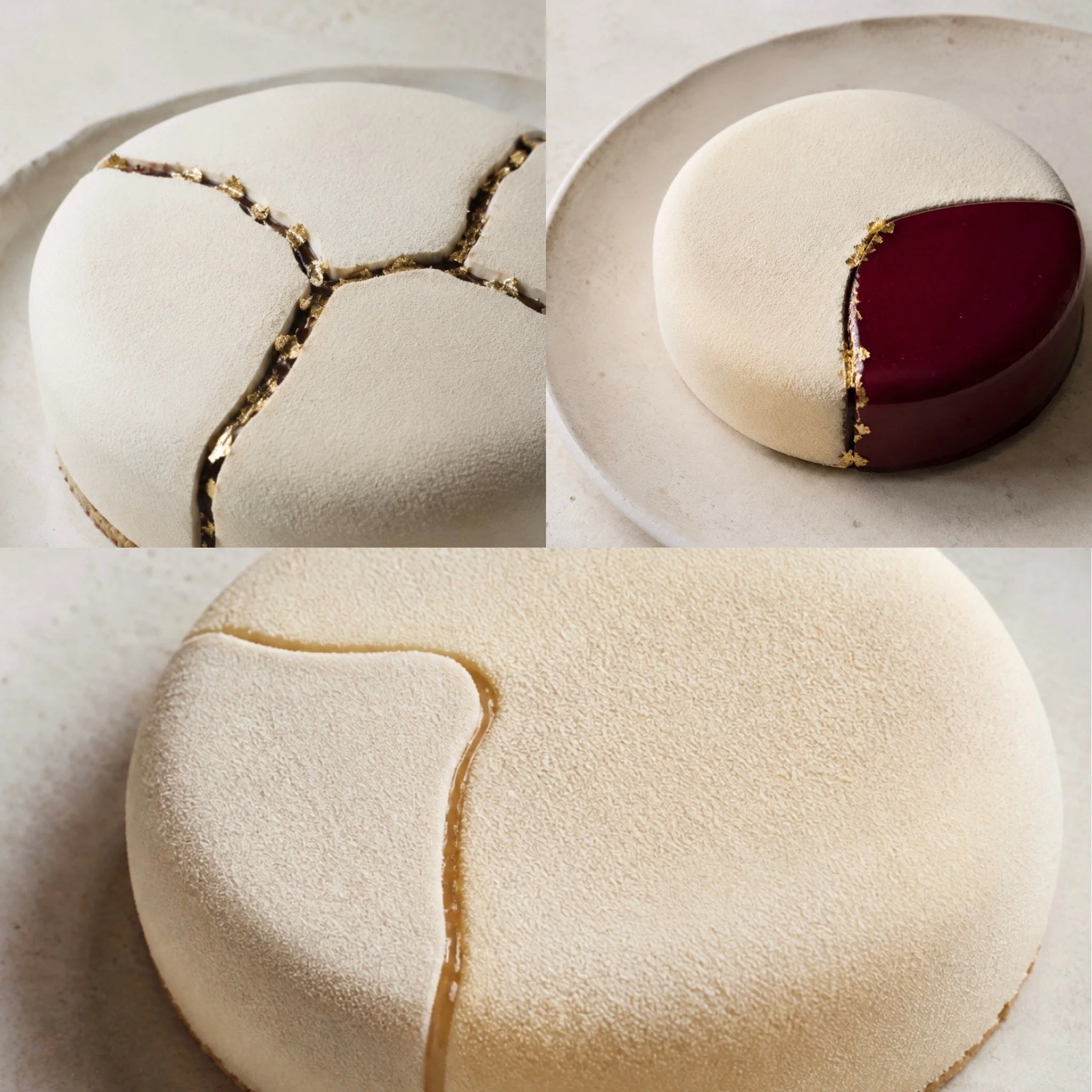
The first dessert takes the kintsugi position without qualification. Ivory velvet is broken by a dark chocolate seam running across the top and down the side, with irregular fragments of gold leaf along its length. The line is not centred, symmetrical or resolved. It forks as real fractures fork, following stress rather than composition. The sablé base remains visible at the bottom edge. Nothing is hidden, including the fact that the object was built.
The second takes the position of yobitsugi. A little more than a third of the entremet is replaced by a foreign element: deep burgundy mirror glaze, wet where the rest is dry, saturated where the rest is pale, reflective where the rest absorbs. Gold marks the vertical border only, and only in fragments. The two surfaces are not blended. They are made to hold a border.
The third takes the position of tomotsugi: not a donor shard masquerading as original, but a join made almost unreadable. The same velvet finish continues across the surface in the same family of tones. A single curved line of amber caramel marks where continuity has been reconstructed. There is no gold and no dramatic contrast. The only signal is a faint difference in the warmth of the spray on either side of the line, and a thin gloss where a matte surface would be expected. You have to be looking.
Of the three, it is the hardest to execute and the least likely to be photographed. That relationship is not accidental.
The objection
Here is the problem with all of it, stated plainly, because the piece is not worth publishing without it.
Nothing was broken.
A repaired bowl carries a real event: it fell, it failed, someone decided it was worth the labour. The seam is a record. On these desserts, the fracture is authored. It was drawn, masked, sprayed and glazed into existence by someone who could have made a continuous surface and chose not to. Calling that repair is a category error. Dressing a technical exercise in the vocabulary of loss would be exactly the kind of manufactured depth that makes people distrust the language of craft.
The desserts are not repairs. They are something narrower and, I think, more defensible.
What pâtisserie has that ceramics does not
A repaired bowl is repaired in order to survive. That is the point: the object is returned to service, and the visible seam is the price of its continuation.
A dessert is not going to survive. It has a working life of a few minutes and is completed by being destroyed. The spoon is not an accident that befalls it; the spoon is the last step of the recipe. Every entremet on every pass in every dining room is already, at the moment it leaves the kitchen, on its way to being broken.
The line on these three surfaces is therefore not the memory of a fracture. It is the prediction of one.
This is the only medium I know in which the repair precedes the break. The seam is drawn before the object is damaged; then the guest arrives and does what the seam anticipated. Ceramics looks backwards at a fracture already survived. Pâtisserie looks forward to one that is certain.
That inversion is the actual subject. The finishes do not make a claim about resilience. They declare, in advance, what an object is willing to admit about its own ending: that it will be broken conspicuously, that something foreign may enter its composition, or that its rupture will be made so quiet that nobody at the table remarks on it.
Restraint
The tomotsugi position is the one worth defending.
Kintsugi photographs well and yobitsugi photographs better; both give the eye an event. Tomotsugi withholds the event. It asks for a surface on which the intervention is present and almost unreadable—where the only evidence is a slight warmth in the spray, a line of caramel where nothing structural appears to be happening, a join that most guests will finish the plate without noticing.
This is difficult to sell and easy to get wrong. Executed poorly, it reads as a flaw in the spray. Executed properly, it produces the effect that matters most in this work and is discussed least: the guest is not told anything. They are left with the faint sense that something has been decided, without being able to say what.
That is the version I would put on a menu.
EDITORIAL NOTE
Kintsugi, yobitsugi and tomotsugi/tomonaoshi belong to Japanese ceramic-repair vocabularies. Their use here is interpretive, not a claim of craft lineage. Terminology varies across workshops and periods; the essay follows Japanese repair usage in distinguishing an introduced donor shard (yobitsugi) from a visually matched restoration (tomotsugi or tomonaoshi).
Fact-check and source note
The publication text has been adjusted in three places: tomotsugi is no longer defined as a fragment borrowed from a matching companion object; kintsugi is described as lacquer finished with metal powder rather than as gold leaf; and the Ashikaga Yoshimasa account is presented as a later origin legend rather than documented invention history.
National Museum of Asian Art, Smithsonian Institution. Japanese Art from the Collection: kintsugi materials, process and the central role of lacquer.
https://asia.si.edu/accessibility/japanese-art-from-the-collection-accessible-label-text/
National Museum of Asian Art, Smithsonian Institution. Gold: lacquer repair predates gilded kintsugi; gilt repairs became fashionable in the sixteenth century.
https://asia.si.edu/explore-art-culture/art-stories/materials-techniques/gold/
National Institutes for Cultural Heritage, Japan. Celadon porcelain bowl named Bakōhan: the surviving clamped bowl and the later recorded Yoshimasa episode.
https://emuseum.nich.go.jp/detail?content_base_id=100886&langId=en
Japan House London. Kintsugi: sixteenth-century use, tea-culture association and the Yoshimasa story described as legend.
https://www.japanhouselondon.uk/read-and-watch/kintsugi/
ORIGEN, Osaka. Japanese ceramic repair glossary: tomotsugi/tomonaoshi as colour- and texture-matched repair; yobitsugi as a donor-shard repair.
https://osaka-origen.com/2024/09/17/repair/
TENPYODO, Ginza. Japanese conservation glossary: tomonaoshi conceals repair by matching colour, pattern and texture; yobitsugi introduces a compatible shard.
https://tenpyodo.com/dictionaries/damage/
Digital Daijisen via Kotobank. Dictionary definition of kintsugi as urushi repair finished with gold, silver or platinum powder.
https://kotobank.jp/word/%E9%87%91%E7%B6%99%E3%81%8E-481548
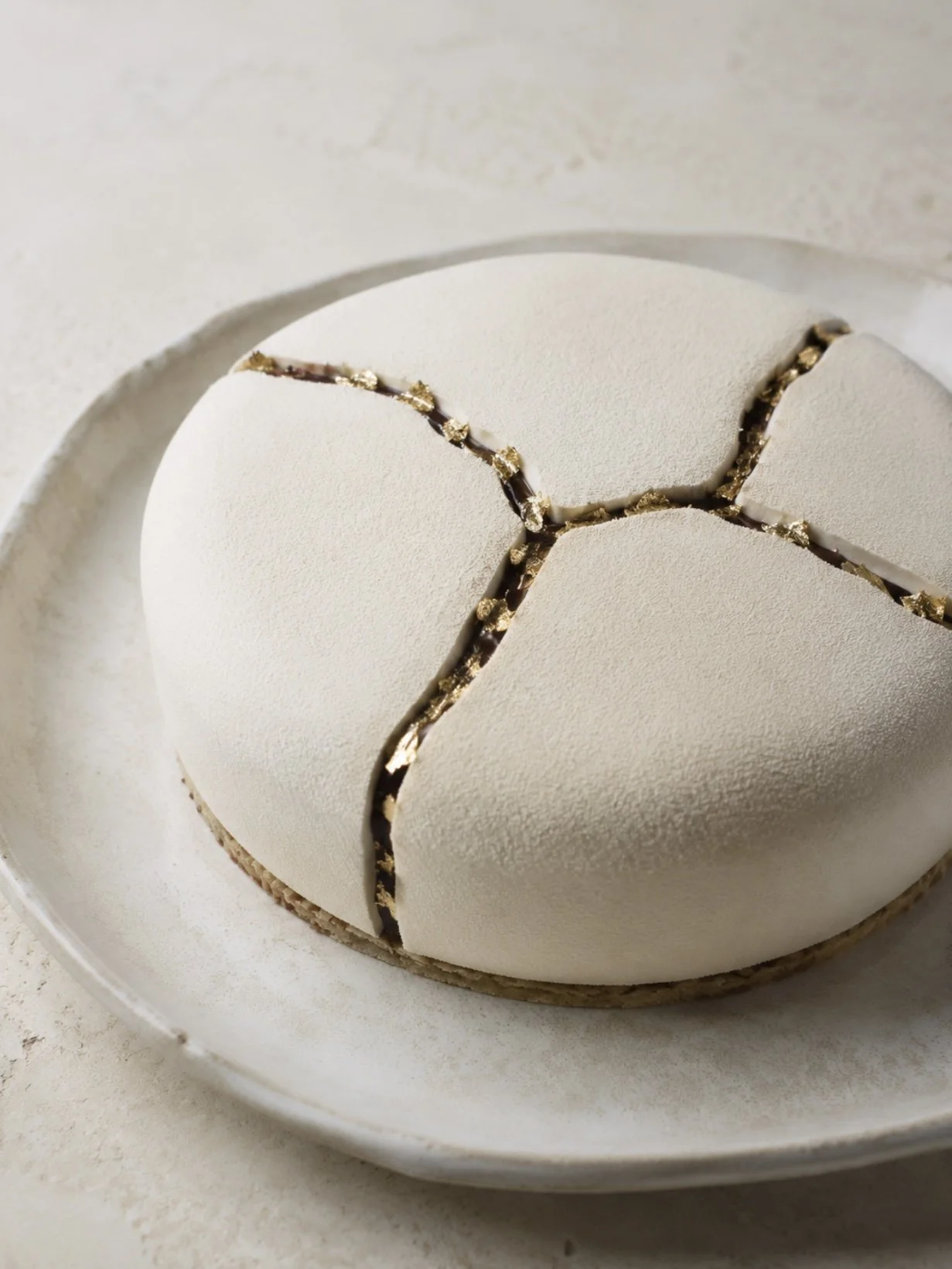
Kintsugi — 金継ぎ, gold joining. Urushi lacquer, dusted or mixed with powdered gold, silver or platinum, and the fracture line raised into the most conspicuous feature of the object. The older word for the practice was kintsukuroi, 金繕い, gold mending; the shift toward -tsugi carries the sense of a repair lifted into beauty rather than merely performed. The break is not forgiven. It is promoted.
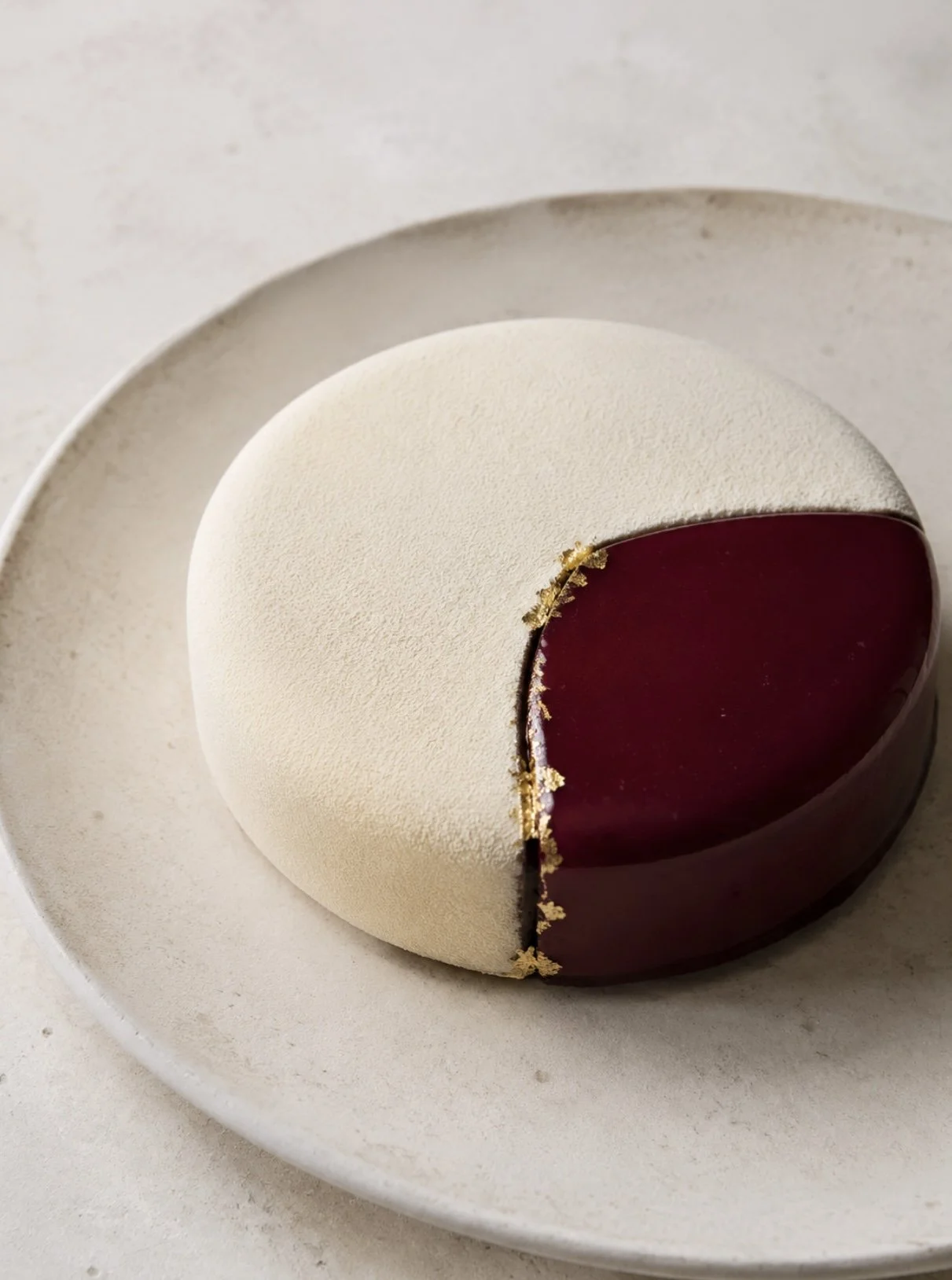
Yobitsugi — 呼び継ぎ, literally calling-join. A fragment is called in from a different vessel altogether to fill what is missing: different clay, different glaze, different provenance, sometimes not ceramic at all. Nothing in the method seeks harmony. The object becomes two objects agreeing to be one.
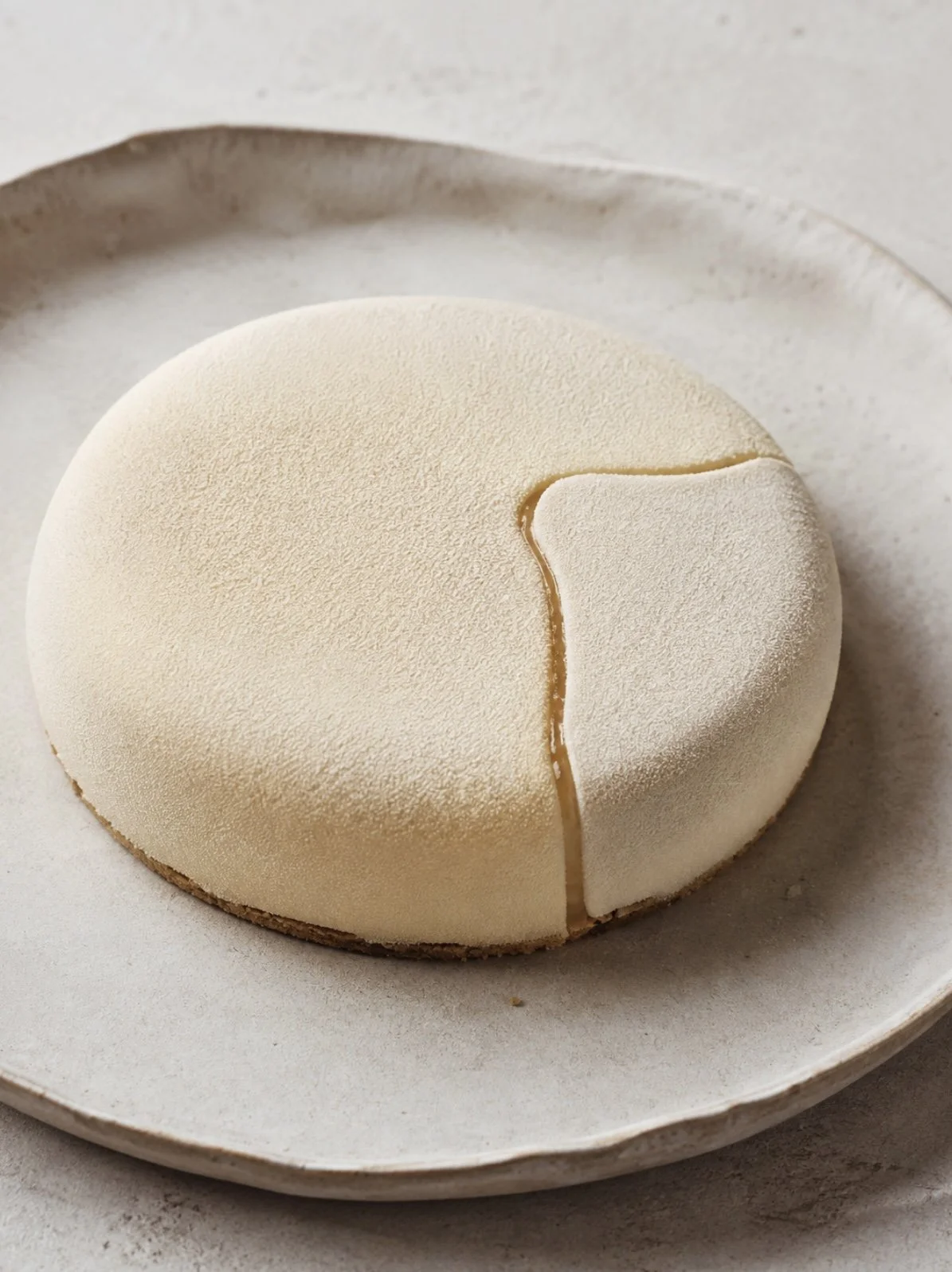
Tomotsugi — 共継ぎ, also 共直し, tomonaoshi. The character 共 carries the sense of the same body, of a piece with. In its older use it means restoring a vessel from its own fragments and nothing foreign. In current practice it more often describes a repair whose lacquer is colour-matched to the original surface so that the join is not read as an event at all. It is the only one of the three that asks not to be seen.
Set in that order, the three are a gradient of disclosure: declare the break, replace the break with a stranger, or match the break to the body until it stops registering.
