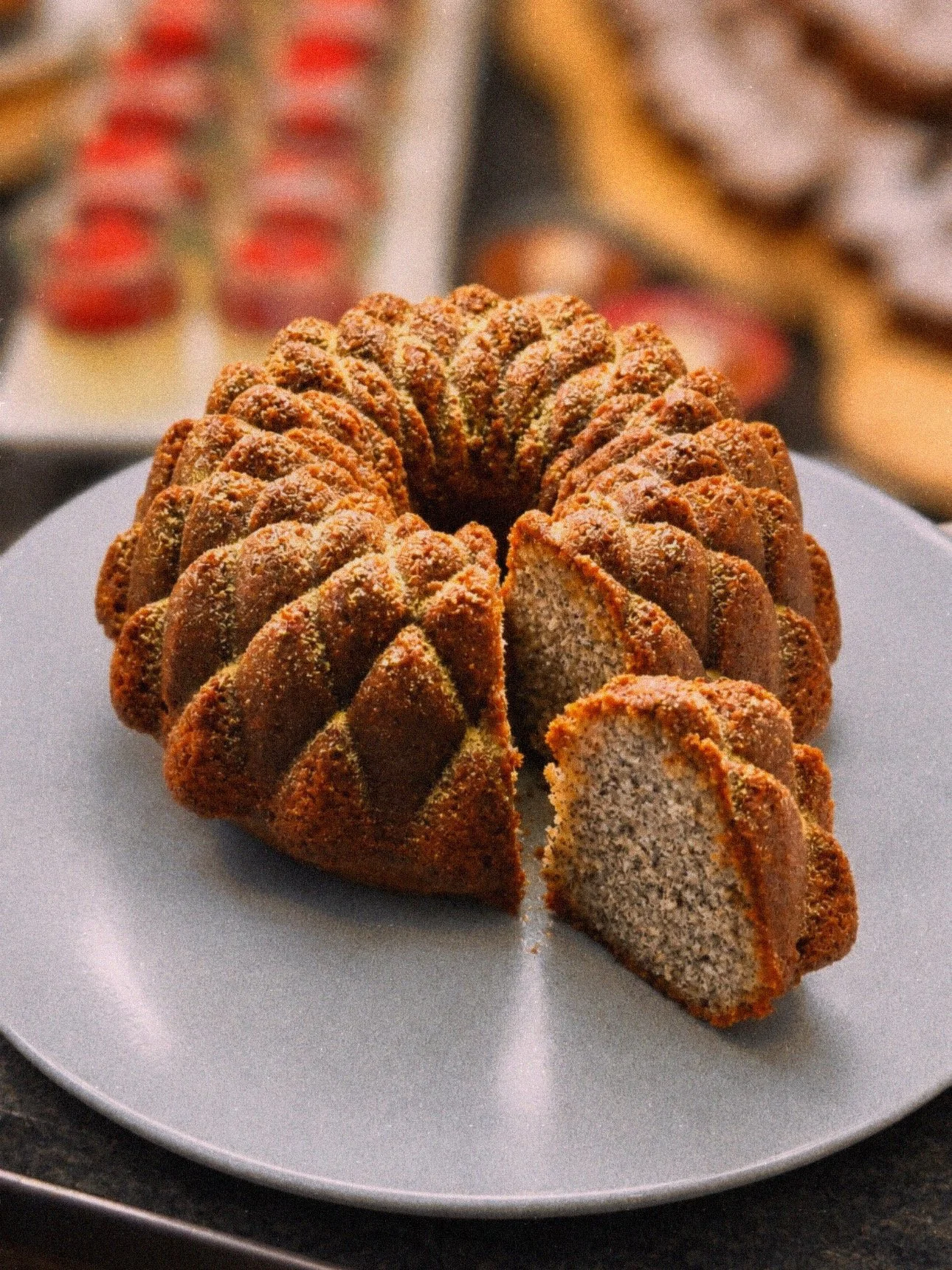
A delicate gluten-free lemon and poppy seed Gugelhupf, featuring a golden, beautifully sculpted crust and a soft, finely textured crumb. The freshness of lemon meets the subtle nuttiness of poppy seeds in this elegant take on a traditional European cake.
Exploring natural flours, functional ingredients and professional pastry techniques to create gluten-free products with exceptional flavour, texture, structure and consistency.
Gluten-free baking has evolved far beyond simply replacing wheat flour with an alternative. It is an increasingly sophisticated area of pastry development, combining ingredient functionality, food science and traditional craftsmanship.
The challenge is not simply to produce something without gluten. It is to create products that deliver the qualities expected from exceptional pâtisserie: a tender crumb, balanced moisture, attractive volume, crisp or delicate textures, appealing flavour and consistent results.
Achieving this requires a different way of thinking about flour, structure and formulation.
Buckwheat is an excellent starting point. Despite its name, it is naturally gluten-free and botanically unrelated to wheat. It offers a distinctive flavour, nutritional diversity and interesting functional properties. However, it is only one part of a much broader approach.
The real opportunity lies in understanding how different flours, starches, proteins, fibres, emulsifiers, hydrocolloids and processing techniques can work together.
This is where gluten-free baking becomes a genuine discipline of professional pastry development.
1. Rethinking flour: Building flavour and functionality
In conventional baking, wheat flour provides much of the structure through gluten development. In gluten-free baking, that responsibility must be distributed across several ingredients.
No single flour can reproduce every property of wheat flour. Successful formulations therefore use carefully considered combinations, with each ingredient contributing different characteristics.
Buckwheat flour: The distinctive foundation
Buckwheat is one of the most interesting ingredients in modern gluten-free pâtisserie.
Its flavour is naturally earthy, nutty and slightly roasted, making it particularly suitable for chocolate cakes, brownies, biscuits, pancakes, financiers and selected breads.
Buckwheat also contains protein, fibre and minerals. Its flavour can bring depth and character to formulations that might otherwise taste predominantly of starch.
However, buckwheat does not form a gluten network, and its flavour can become dominant when used at high levels.
Potential applications:
Chocolate cakes and brownies
Biscuits and shortcrust products
Pancakes and crêpes
Financiers and tea cakes
Selected breads and breakfast pastries
The key is to use buckwheat strategically, balancing its flavour with more neutral flours and suitable functional ingredients.
Almond flour: Richness and tenderness
Almond flour contributes fat, protein, flavour and tenderness.
It is particularly useful in cakes, financiers, macarons, tart fillings and biscuits, where richness and a moist texture are desirable.
Its natural fat content can improve mouthfeel and reduce the dry sensation sometimes associated with gluten-free products.
However, almond flour does not provide the same structural behaviour as cereal flour. Excessive quantities can produce dense, fragile or greasy results.
Sorghum flour: A versatile cereal alternative
Sorghum flour has a relatively mild, slightly sweet flavour and can provide useful body in gluten-free formulations.
It can be used in cakes, biscuits, muffins and bread blends.
Its flavour is generally more neutral than buckwheat, making it useful when developing products with a familiar cereal profile.
Rice flour: A neutral structural component
Rice flour is widely used in gluten-free baking because of its neutral flavour and versatility.
Fine rice flour can contribute structure to cakes, biscuits and pastry blends. Particle size is particularly important.
Coarse rice flour can create a gritty or sandy mouthfeel, especially in delicate products.
For professional pâtisserie, finely milled flour and consistent particle size are important considerations.
Oat flour: Softness and flavour
Appropriately controlled gluten-free oat flour contributes a mild, cereal-like flavour and can help create a softer texture.
It is particularly suitable for cookies, muffins, breakfast products and selected cakes.
For products intended for people with coeliac disease, the oat supply chain and individual suitability require particular attention.
Coconut flour: High absorption capacity
Coconut flour is rich in fibre and absorbs considerably more water than many conventional flours.
It can contribute flavour and nutritional diversity, but it is not a straightforward flour replacement.
Used excessively, it can create dry, dense and crumbly products.
Its inclusion requires careful adjustment of liquid, fat and binding systems.
Chickpea flour: Protein and character
Chickpea flour provides protein and a distinctive savoury, nutty flavour.
It can be useful in crackers, savoury pastry, flatbreads and selected biscuits.
Its flavour needs careful consideration in sweet pâtisserie, where it is generally better used at modest levels or combined with more neutral ingredients.
Additional ingredients worth exploring
Other useful ingredients include:
Millet flour: mild flavour and useful diversity in flour blends.
Teff flour: distinctive flavour and interesting applications in breads, pancakes and selected cakes.
Quinoa flour: protein-rich, with a characteristic flavour that benefits from controlled inclusion.
Tigernut flour: naturally sweet, fibrous and useful in selected biscuits and cakes.
Chestnut flour: sweet, aromatic and particularly interesting in seasonal pâtisserie.
The objective is not to use as many flours as possible. It is to select ingredients according to the product being developed.
2. Starches: Creating structure, volume and texture
Flours provide flavour, proteins, fibre and body. Starches play a different but equally important role.
They influence viscosity, gelatinisation, moisture retention, crumb structure and the final texture of baked products.
Potato starch
Potato starch can contribute softness, moisture retention and a light texture.
It is useful in selected cakes and bread formulations.
Tapioca starch
Tapioca starch contributes binding, elasticity and a characteristic chew.
It can improve flexibility in certain gluten-free products, although excessive quantities may create a gummy texture.
Cornstarch
Cornstarch is useful for creating delicate textures in biscuits, sponge cakes, custards and pastry creams.
It can also reduce the perception of heaviness in some flour blends.
Rice starch
Rice starch offers a neutral flavour and can contribute to delicate textures, particularly in products where a fine crumb is important.
Pregelatinised starch
Pregelatinised starch has already undergone a gelatinisation process and can absorb water without requiring the same level of heating as native starch.
It can be useful for improving cold-water binding, batter consistency and moisture distribution.
Modified starches
Selected modified starches can improve freeze-thaw stability, viscosity, moisture management and processing tolerance.
Their functionality depends on the specific modification and application. They should be selected according to the product’s requirements rather than treated as interchangeable ingredients.
High-amylose starches
High-amylose starches can behave differently from conventional starches, particularly in gel formation and retrogradation.
They may be useful in specialised texture development, but require testing because they can also influence firmness and staling.
The professional principle: starch selection should be based on the texture required, not simply on the availability of a gluten-free ingredient.
3. Hydrocolloids: Developing structure without gluten
Hydrocolloids are important tools in professional gluten-free formulation.
They interact with water and influence viscosity, stability, elasticity and moisture retention.
They do not recreate gluten itself. Instead, they can help build alternative structures that support gas cells, reduce crumbling and improve handling.
Xanthan gum
Xanthan gum is a thickening and stabilising agent.
It can improve batter viscosity, reduce ingredient separation and help maintain structure during baking.
However, excessive quantities can create an overly elastic, sticky or gummy texture.
Guar gum
Guar gum provides viscosity and water binding.
It can be useful in cakes, biscuits and bread formulations, including in combination with other hydrocolloids.
Locust bean gum
Locust bean gum can contribute body and texture, particularly in combination with other gums.
Its performance depends on hydration, temperature and the other ingredients present.
Hydroxypropyl methylcellulose
Hydroxypropyl methylcellulose, commonly known as HPMC, is particularly valuable in gluten-free bread development.
It can help stabilise gas cells and form a thermally responsive structure during baking.
This makes it useful in applications where volume and crumb stability are important.
Its suitability for cakes and other pastry products must be assessed separately.
Psyllium husk
Psyllium is a fibre-rich ingredient that absorbs water and forms a gel.
It can improve dough cohesion, flexibility and moisture retention.
It is especially useful in bread, rolls, pizza dough and selected pastry applications.
Carboxymethyl cellulose
Carboxymethyl cellulose, commonly known as CMC, can contribute viscosity, water retention and texture control.
Its functionality depends on the formulation and the specific grade used.
Choosing the right hydrocolloid
There is no universal hydrocolloid system.
A bread dough, sponge cake, biscuit and laminated pastry have different structural requirements.
The goal is to use the minimum effective amount of a suitable system, then evaluate its performance through controlled trials.
4. Emulsifiers: Improving aeration, stability and mouthfeel
Emulsifiers are particularly important in cake development because they help manage the relationship between fat, water and air.
A successful cake batter must maintain a stable structure while air is incorporated and the product moves through baking.
Without a suitable emulsification system, gluten-free cakes can experience:
Poor aeration
Uneven crumb structure
Low volume
Excessive density
Fat separation
Inconsistent results
Several types of emulsifying ingredients can be considered.
Lecithin
Lecithin is a naturally occurring phospholipid emulsifier, available in different forms, including sunflower and soy lecithin.
It can help stabilise fat-water systems and improve batter handling.
It is useful in selected cakes, biscuits, chocolate applications and fillings.
However, lecithin is not necessarily a complete replacement for a dedicated cake emulsifier. Its performance depends on the formulation, dosage and processing method.
Citrus fibre
Citrus fibre is a plant-derived functional ingredient that can contribute water binding, stabilisation and texture control.
Depending on its specification and application, it can help support certain emulsion systems.
It may be particularly interesting in formulations where water management and plant-derived ingredients are priorities.
It should not be assumed to behave identically to conventional phospholipid emulsifiers.
Professional cake emulsifier systems
Specialised cake emulsifier systems can help improve aeration, batter stability, volume and crumb uniformity.
They are often useful in sponge cakes and high-ratio cake formulations.
Different systems have different compositions and performance characteristics. They should not be assumed to be interchangeable with lecithin or citrus fibre.
How should emulsifier systems be evaluated?
A professional development trial could compare:
A control formulation without an added emulsifier.
The same formulation with lecithin.
The same formulation with a citrus-fibre system.
The same formulation with a suitable professional cake emulsifier.
The comparison should use the same ingredients, mixing conditions, baking conditions and evaluation criteria.
This helps establish which system performs most effectively for the specific product being developed.
5. Proteins: Supporting structure and texture
Gluten-free formulations can benefit from carefully selected protein ingredients.
Proteins may contribute water binding, emulsification, browning, foam stability and structural development.
Their functionality varies considerably.
Egg proteins
Eggs remain among the most effective structural ingredients in pastry.
They contribute emulsification, aeration, coagulation and richness.
In gluten-free cakes, they can play an important role in supporting volume and crumb structure.
Milk proteins and whey protein
Milk proteins can contribute emulsification, browning and structural properties.
Whey protein can also influence foam formation and moisture management.
However, excessive quantities can create a firm or dry texture.
Egg white powder
Egg white powder can be useful when additional protein functionality or consistency is required.
It is particularly relevant in aerated products, meringue systems and selected cake formulations.
Potato protein
Potato protein is a plant-derived option with potential foaming and emulsifying properties.
Its suitability depends on the grade and application.
Pea and soy proteins
Plant proteins can contribute nutritional value and functional properties.
However, they can introduce distinctive flavours and may affect texture, colour and water absorption.
They should be tested carefully before being incorporated into delicate sweet pastry.
The key principle: proteins should be selected according to their functional contribution, not simply their protein percentage.
6. Enzymes, moisture management and advanced formulation
Professional gluten-free development does not stop with flour, starch, gums and emulsifiers.
Several additional technologies can help improve consistency and product performance.
Enzymes
Enzymes are highly specific ingredients. Their performance depends on the substrates available, processing conditions and dosage.
Potential applications include:
Amylases: modify starch and can influence crumb softness, browning and staling.
Maltogenic amylase: can help delay crumb firming in suitable products.
Xylanase: acts on arabinoxylans, making it relevant only when appropriate substrates are present in the formulation.
Glucose oxidase: can modify certain protein systems through oxidative reactions, but its usefulness depends on the available proteins and formulation chemistry.
Transglutaminase: can promote protein cross-linking when suitable protein substrates are available.
These enzymes are not universal gluten replacements.
Their use requires application-specific trials and confirmation that the selected enzyme is permitted for the intended food category and market.
Humectants and moisture management
Moisture is one of the biggest challenges in gluten-free baking.
Some products dry out quickly, while others become sticky or gummy.
Ingredients that can help manage moisture include:
Invert sugar
Glucose syrup
Trehalose
Glycerol
Sorbitol
These ingredients can influence water activity, softness, sweetness and shelf life.
They are not interchangeable, and their use should be balanced against flavour, texture, labelling and regulatory requirements.
Fat selection and engineering
Fat selection has a major influence on gluten-free texture.
Butter contributes flavour and plasticity. Oils can improve softness and moisture perception. Cocoa butter and specialised fats can influence setting behaviour and mouthfeel.
In laminated pastry, fat crystallisation and plasticity become especially important.
The fat must remain sufficiently plastic during lamination while maintaining the desired separation between layers.
Fermentation and leavening
Fermentation can contribute flavour, aroma and acidity to gluten-free breads.
However, the dough must have sufficient structure to retain the gas produced.
Chemical leavening systems are equally important in cakes and biscuits.
The balance of bicarbonate, acid, moisture and batter composition influences volume, colour and final texture.
7. Building a practical gluten-free flour blend
A useful starting point for development is to combine neutral flours, flavourful flours and starches.
The following blend is an experimental starting point for selected cake and pastry applications. It is not a validated universal replacement for wheat flour.
Example development blend
Ingredient
Percentage
Fine white rice flour
30%
Sorghum flour
20%
Potato starch
20%
Tapioca starch
10%
Almond flour
15%
Buckwheat flour
5%
Total
100%
This blend offers:
A relatively neutral cereal base
Additional body from sorghum
Softness from potato starch
Binding and elasticity from tapioca
Richness from almond flour
Character and flavour from buckwheat
The blend should be assessed in the specific product being developed.
A sponge cake, biscuit, tart shell and bread will not necessarily perform equally well with the same composition.
The flour blend is only one part of the formulation. The final result also depends on liquid, sugar, fat, eggs, emulsification, hydrocolloids, mixing method and baking conditions.
8. Applying the science to professional pâtisserie
The best gluten-free formulation is not the one containing the greatest number of functional ingredients.
It is the one in which each ingredient has a clear purpose.
Different pastry products require different technical approaches.
Cakes and sponge cakes
Cakes require a stable aerated batter that can retain air until the structure sets.
Key considerations include:
Flour and starch balance
Batter viscosity
Egg functionality
Emulsifier selection
Fat distribution
Baking temperature and time
Cooling and moisture management
A suitable cake emulsifier may improve volume and crumb consistency, but it should be compared against simpler systems before being adopted.
Biscuits and cookies
Biscuits require a different balance of spread, crispness, tenderness and moisture.
Important factors include:
Flour particle size
Fat composition
Sugar type
Starch selection
Water content
Dough resting time
Baking profile
Buckwheat, almond, rice and sorghum can all be valuable ingredients in this category.
Tart shells and shortcrust pastry
The challenge is to create a dough that can be rolled, shaped and baked without excessive cracking or crumbling.
Useful formulation strategies include:
Fine flour blends
Appropriate fat content
Carefully managed hydration
Psyllium or selected hydrocolloids where appropriate
Adequate resting time
Controlled baking
The objective is a crisp, clean bite without a sandy or fragile texture.
Choux pastry
Choux pastry is particularly challenging because it depends on steam expansion and the ability of the cooked paste to retain its shape.
The formulation must manage water absorption, starch gelatinisation, egg incorporation and final structural setting.
A successful gluten-free choux system requires product-specific development rather than a simple flour substitution.
Croissants and laminated pastry
Gluten-free lamination is one of the most demanding areas of pastry development.
Traditional croissant dough depends on gluten development to provide extensibility and gas retention.
Without gluten, the dough must achieve suitable flexibility and handling through a carefully engineered combination of starches, proteins, hydrocolloids, fats, hydration and processing.
Important development variables include:
Dough extensibility
Resistance to tearing
Fat plasticity
Lamination temperature
Layer integrity
Proofing stability
Baking expansion
A promising formulation must be tested through repeated lamination and baking trials.
It should not be assumed that a blend suitable for cakes or biscuits will work in croissants.
Bread and rolls
Gluten-free bread requires particular attention to gas retention, dough viscosity, crumb structure and moisture.
HPMC, psyllium and other hydrocolloids can be useful tools, but the right system depends on the flour and starch composition.
The goal is a loaf with good volume, a soft crumb, acceptable elasticity and a texture that remains pleasant after cooling and storage.
9. The professional development process: From concept to reliable product
Ingredient selection is only the beginning.
A professional gluten-free product should be developed through a controlled and repeatable process.
Step 1: Define the target product
Before changing the formulation, define the desired result.
For a cake, this might include:
Fine, even crumb
Good volume
Moist but not gummy texture
Clean flavour
Easy slicing
Consistent appearance
For a biscuit, the priorities may instead be crispness, controlled spread and a clean snap.
Step 2: Establish a control formulation
Create a reference product and record the full formulation in baker’s percentages or another consistent weight-based format.
Record ingredient specifications where relevant.
This creates a baseline for meaningful comparison.
Step 3: Change one variable at a time
Avoid changing flour composition, emulsifier, gum and hydration simultaneously.
If too many variables change together, it becomes difficult to understand why the product improves or deteriorates.
A controlled trial programme should isolate important factors before exploring combinations.
Step 4: Measure the results
Professional evaluation should combine sensory assessment with measurable product characteristics.
Useful measurements include:
Evaluation
What it reveals
Batter density
Aeration and mixing consistency
Batter viscosity
Flow and handling behaviour
Cake volume
Expansion and structure
Weight loss during baking
Moisture loss
Crumb firmness
Texture and potential staling
Crumb structure
Cell size and distribution
Moisture content
Product composition
Water activity
Available water for microbial growth
Sensory assessment
Flavour, aroma and eating quality
Water activity should not be treated as a stand-alone guarantee of safety or shelf life. Microbiological validation, packaging and storage conditions also matter.
Step 5: Evaluate storage performance
A product that performs beautifully on the day of baking may deteriorate quickly.
Assess:
Day-one texture
Day-two and day-three texture
Moisture migration
Crumb firming
Flavour changes
Packaging performance
Microbiological stability where relevant
For frozen products, include freeze-thaw trials.
A professional product must perform consistently throughout its intended distribution and storage cycle.
Step 6: Optimise for commercial production
A successful laboratory sample is not automatically a commercially viable product.
Consider:
Ingredient availability
Ingredient cost
Batch-to-batch consistency
Mixing and production time
Equipment compatibility
Allergen management
Packaging
Shelf life
Regulatory compliance
The final formulation must be technically effective and commercially realistic.
10. Ingredient interactions: Why combinations matter
One of the most important lessons in gluten-free baking is that ingredients do not work independently.
A change in one component can influence several other properties.
For example:
Increasing psyllium may improve dough cohesion but also increase water demand.
Increasing tapioca starch may improve elasticity but create excessive chew or gumminess.
Adding almond flour may improve tenderness but reduce the proportion of structural starch.
Increasing protein may improve certain structural properties but also create a firmer or drier crumb.
Adding an emulsifier may improve batter stability, but the result depends on the fat system and mixing method.
Increasing sugar may improve moisture perception but also affect spread, browning and structure.
For this reason, ingredient interaction should be studied systematically.
A practical development matrix can compare flour composition, hydration and functional systems while keeping the process consistent.
The aim is to understand not only which formulation performs best, but why it performs best.
11. Quality, nutrition and food safety
Gluten-free does not automatically mean healthier, lower in calories or nutritionally superior.
A well-designed gluten-free product can offer flavour, variety and nutritional diversity, particularly when it incorporates ingredients such as buckwheat, sorghum, oats, nuts and seeds.
However, the nutritional profile depends on the complete formulation.
Professional development should consider:
Fibre content
Protein quality and quantity
Sugar levels
Fat composition
Salt levels
Portion size
Overall nutritional balance
For products intended for people with coeliac disease, gluten control is essential.
In the European Union, the regulated claim “gluten-free” requires the food as sold to the final consumer to contain no more than 20 mg/kg of gluten.
This requires appropriate ingredient sourcing, production controls, cleaning procedures and cross-contamination management.
Ingredients such as oats require particular attention to supply-chain controls.
Allergen management is also essential, especially when using almonds, other nuts, milk, eggs and soy.
Regulatory requirements for additives, enzymes and labelling must be checked for the intended market and food category.
12. The future of gluten-free pâtisserie
The future of gluten-free baking is not about finding one perfect substitute for wheat.
It is about understanding ingredients at a deeper level and combining them with precision.
Buckwheat, sorghum, rice, millet, teff, almonds and other alternative flours provide opportunities to develop distinctive flavours and textures.
Starches, proteins, hydrocolloids, emulsifiers and enzymes offer additional control over structure, moisture, aeration and stability.
But technology alone does not create exceptional pâtisserie.
The final product still depends on the pastry chef’s understanding of flavour, texture, temperature, mixing, baking and balance.
The most successful gluten-free products will be those in which the science is invisible to the customer.
They will simply taste exceptional.
Conclusion: Beyond substitution, towards innovation
Gluten-free baking should not be viewed as a compromise or a secondary category of pastry.
It is an opportunity to rethink traditional formulations, explore new ingredients and develop products with their own identity.
Buckwheat is a compelling ingredient because it offers flavour and character, but its true potential becomes clear when it is combined intelligently with other flours and functional systems.
For professional pastry chefs, the path forward is clear:
Understand the ingredient. Define the desired texture. Formulate with purpose. Test systematically. Measure the results. Refine the process.
That is how gluten-free baking moves beyond simple substitution and becomes exceptional pâtisserie.
Legal and Editorial Disclaimer
This article is an independent educational and informational discussion of gluten-free baking, pastry techniques and general ingredient functionality. It is not intended to provide professional, scientific, nutritional, medical, legal, regulatory or commercial advice.
The article uses generic ingredient names and descriptions. It does not promote, endorse, advertise or claim any commercial relationship with a particular manufacturer, supplier, brand or organisation.
All examples of ingredients, formulations, processing methods and technical applications are presented for general educational discussion. They are not represented as tested, validated, commercially approved or suitable for every product or production environment.
Ingredient performance can vary according to composition, grade, supplier, processing conditions, equipment, storage and other factors. No guarantee is made regarding the results, performance, safety, nutritional characteristics, gluten-free status, shelf life or commercial suitability of any formulation discussed.
Readers are responsible for independently assessing and verifying the suitability of any ingredient, formulation or process before applying it. Anyone manufacturing, distributing or selling food products must undertake appropriate testing and comply with all applicable requirements concerning food safety, allergen management, cross-contamination, labelling, product claims, ingredient authorisation and shelf-life validation.
The information is provided in good faith for general discussion. However, no representation or warranty, express or implied, is made that it is complete, accurate, current or suitable for a particular purpose.
To the fullest extent permitted by applicable law, the author excludes liability for loss or damage arising from reliance on or use of the information in this article. Nothing in this disclaimer excludes or limits liability where such exclusion or limitation is prohibited by law or where liability cannot legally be excluded.
This article does not claim ownership of third-party intellectual property, nor does it grant permission to reproduce or use any third-party material.
The author reserves the right to correct or update the article where considered appropriate.
Publication note: This article is intended as independent educational commentary. It should not be interpreted as a guarantee, certification, professional instruction or substitute for independent technical and legal assessment.
