What the Moulds Know: On Travel, Sweetness, and the Education of a Chef
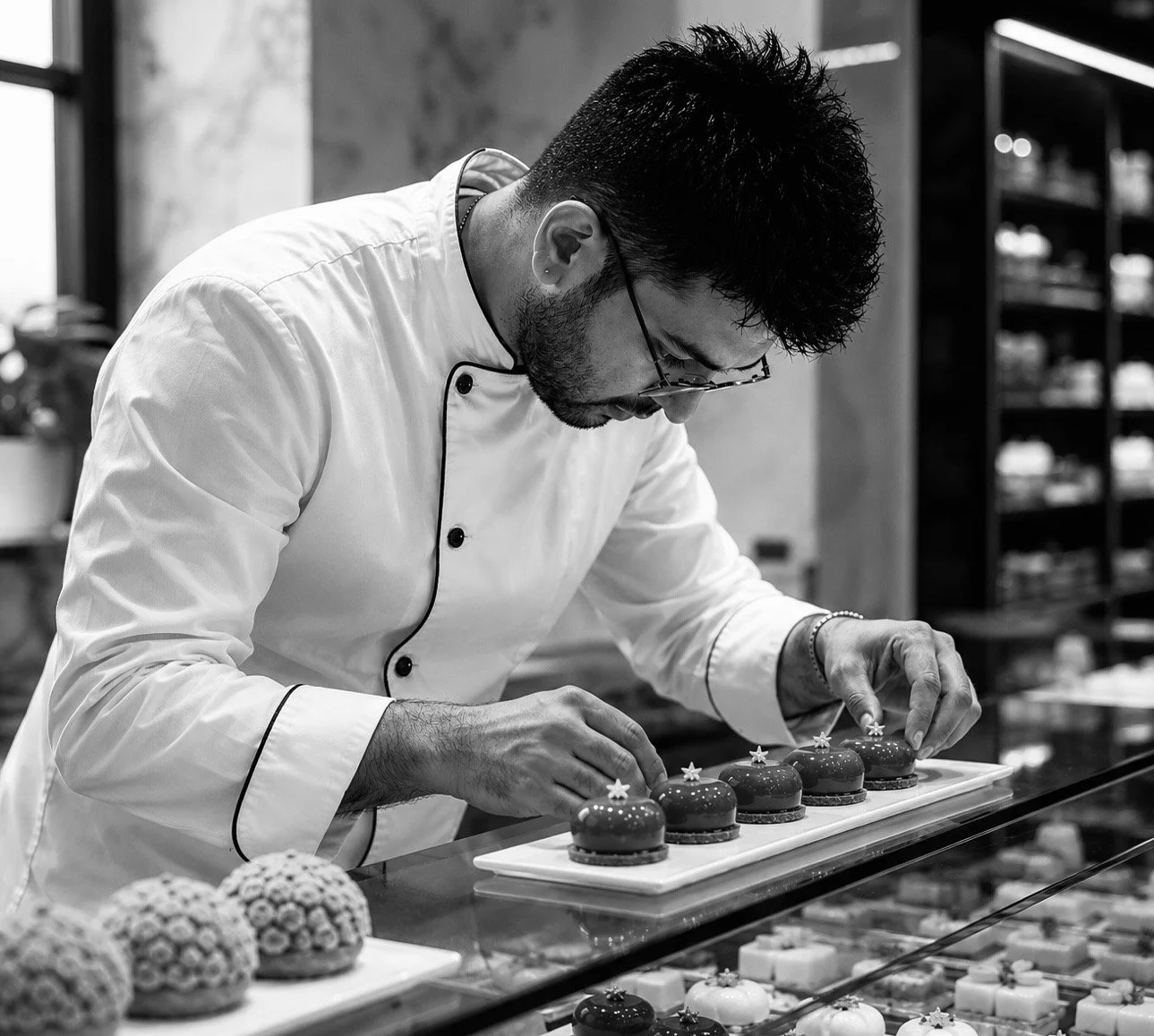
Chef Pâtissier Yogesh Dutt finishing a selection of handcrafted pastries. The image reflects the quiet precision, patience, and craftsmanship that shape the reflections explored in this essay.
By Yogesh Dutt — Chef Pâtissier & Hospitality Adviser
There is a moment every travelling chef knows. You are standing in a market — perhaps at dawn, perhaps in a language you do not yet speak — and something on a stall stops you completely. A fruit you have never seen. A smell you cannot place. A method of wrapping, fermenting, or drying something that belongs to a tradition centuries older than any culinary school curriculum. In that moment, the knowledge you arrived with becomes insufficient. And something better takes its place: curiosity without a technique to resolve it.
I have had that moment in Delhi's Chandni Chowk, watching mithai being pressed into brass moulds that my great-grandfather's generation would have recognised without explanation. I have had it standing at the edge of a fjord in northern Norway at two in the morning in July, the sun still low and orange on the water, understanding for the first time that restraint is not an aesthetic choice — it is what honesty looks like in a landscape that gives you almost nothing. I have had it in the Eastern Townships of Quebec, tasting a maple reduction so calibrated in its bitterness-sweetness tension that it reorganised something structural in how I understood flavour. And I have had it in Sylt — that thin sliver of German island that feels more Scandinavian than European — where the salt in the air is not a metaphor. It is an ingredient. It lands on your tongue before you have eaten anything at all.
Travel does not merely inspire the chef. It restructures how the chef thinks — and more importantly, what the chef considers worth thinking about.
The Myth of the Finished Palate
Western culinary tradition carries an implicit assumption that has shaped professional kitchens for more than a century: that there is a canon of techniques, a hierarchy of flavours, and a correct grammar of taste — and that the educated palate eventually arrives at mastery of this canon. The grande cuisine of France, codified by Escoffier, gave the world a common language. It also gave the world, unintentionally, a frame that made certain flavours instantly legible and others genuinely difficult to place — not because they were inferior, but because they operated in a different grammar entirely.
This is not a criticism of the French tradition. It is one of the most extraordinary contributions any culture has made to the art of feeding people with intention. When I completed my MBA in Luxury Brand Management at INSEEC in France, I understood something about that tradition I had not expected: the principles underpinning French luxury — coherence of identity, discipline of execution, the absolute primacy of the guest's emotional experience — are transferable. They apply to great pastry from any origin. The grammar holds. What changes, country by country, kitchen by kitchen, season by season, is the vocabulary.
The problem arises when the grammar becomes the ceiling rather than the floor. A chef who has only ever learned to think in one culinary language will, eventually, reach the limits of what that language can say. The flavours available to them are the flavours of that tradition. The textures, the temperatures, the moments of genuine surprise — all drawn from the same well. They can execute with extraordinary precision and still, at some level, be repeating themselves.
Travel breaks the ceiling. Not by adding influences the way you might add ingredients, but by forcing a more fundamental reckoning: the realisation that what you have been calling taste is, in part, familiarity — and that the two are not the same thing.
What No Kitchen Can Teach You
When I left the luxury hotels of Abu Dhabi and Dubai — where the standard was international, the expectation global, and the guests drawn from every corner of the world — and moved to Norway, I encountered something I had not anticipated. The Nordic philosophy of simplicity was not merely an aesthetic preference or a design trend that had extended itself into food. It was an ethics. A position taken.
The Norwegian approach to ingredients — seasonal to the point of severity, local to the point of limitation — forced me to confront a question I had never seriously sat with before: what does this place actually taste like? Not what can I produce here using the techniques I arrived with. Not what would impress a guest who has eaten at Michelin-starred restaurants in Paris and Tokyo. But what does the identity of this particular landscape, this particular season, this particular people demand of a dessert?
The answer, when I found it, changed how I worked permanently. A dessert built from what a place genuinely offers — rather than what a global supply chain makes available — carries a kind of honesty that guests register before they can name it. It belongs. It does not feel like it has been airlifted in from somewhere else and plated. And belonging, in hospitality, is where emotion begins.
Canada extended the lesson. At Manoir Hovey in the Eastern Townships of Quebec — a Relais & Châteaux property whose identity is inseparable from its landscape — I encountered the specificity of a terroir I had no framework for. The maple, the wild berries, the cold-climate stone fruit, the particular quality of Quebec dairy in autumn. Flavours that had no close equivalent in my previous experience and could not be approximated by substitution. They had to be understood on their own terms. Which meant I had to learn, at least partially, the culture that had produced them — the agricultural calendar, the French-Canadian relationship with sweetness and preservation, the particular pride that a place takes in its own table.
You cannot learn that from a cookbook. You learn it by being there, by eating badly and well, by asking questions that expose your ignorance, and by staying long enough that the place begins to feel less foreign and more instructive.
Food Has Always Moved Faster Than People
Food has always moved faster than people. Long before states negotiated treaties, spices travelled, and the routes they took — the Silk Road, the Indian Ocean trade networks, the trans-Saharan caravan paths — were the first sustained systems of cross-cultural exchange the world produced. The flavour of a distant place arrived in a kitchen long before any formal relationship existed between the cultures involved.
Consider what this means practically. Chilli, native to the Americas, was introduced to South Asia by Portuguese traders in the sixteenth century. It is now so thoroughly woven into Indian cuisine — into the very identity of Indian food as understood globally — that most people who cook with it daily have never registered it as a foreign import. It arrived, it was understood, it was absorbed, it became the thing itself. Vanilla, native to Mexico, followed Spanish colonisers to Europe and became the defining flavour of French pâtisserie — the neutral sweetness against which all other flavours are measured in the Western dessert tradition. Saffron from Persia built itself into the rice traditions of Spain, the risotto of Milan, the biryani of Hyderabad. These are not decorative cultural footnotes. They are the foundation of what we think of as each of those cuisines.
The history of gastronomy is the history of the world's peoples refusing to leave each other's food alone. And that refusal has, in the long run, produced something more nourishing than any single tradition could have managed in isolation.
What travel does for the contemporary chef is make this process conscious rather than accidental. I am not Japanese. I have not trained in Japan. But I have spent enough time studying Japanese culinary philosophy — the concept of ma, the meaningful pause; the acceptance embedded in wabi-sabi of what is imperfect, impermanent, incomplete — to understand that these are not decorative aesthetics. They are functional positions about what food is for. When I plate a dessert with negative space, when I resist the impulse to fill every corner of a plate, I am not imitating a visual style. I am operating from a philosophical position that I encountered in a tradition not my own and found to be true. The difference matters. Imitation closes the conversation. Understanding opens it.
In this sense, the well-travelled chef is not merely a more technically resourced chef. They are a more honest one — someone who has been forced, repeatedly, to discover the precise location of what they do not know.
The Same Mould, Pressed Everywhere
Of all the courses on a menu, the dessert is the most culturally legible — and the most revealing of what a culture actually values.
Every civilisation on earth has a tradition of sweetness. Of endings. Of celebration. Of the specific comfort that sugar and warmth and fat provide when offered with care. But the forms these traditions take are as different as the peoples who produced them, and the differences are not superficial. They encode climate, agriculture, religion, social structure, and a culture's fundamental relationship with pleasure and restraint.
I understood this most clearly not in a professional kitchen but at a table in Dubai, during Eid, when a colleague's mother served ma'amoul — date-filled semolina pastries pressed into carved wooden moulds almost identical in design and purpose to the mithai moulds I had watched being used in Chandni Chowk as a child. Two cultures separated by geography, religion, and culinary tradition, pressing sweetness into shaped wood for the same reason: to mark the moment, to honour the guest, to make an ordinary day into something that would be remembered. The French mille-feuille does the same thing with laminated dough and cream. The Japanese wagashi does it with azuki bean and rice flour and a precision of form that is itself a kind of reverence. The German Stollen, dusted in icing sugar as though it has just come in from the snow, does it with dried fruit and marzipan and a shape unchanged in five centuries. The Nordic Julekake does it with cardamom and quiet. The forms could not be more different. The impulse behind them is so identical that once you have seen it clearly — once you have sat at enough tables in enough countries and felt the same thing being offered in a completely different language — it becomes very difficult to argue that these traditions are separate things rather than one thing expressed in the only vocabulary each place had available.
When I created the Amalie signature cake at Kempinski Hotel Taschenbergpalais Dresden — a chocolate tartlet built around the flavours of Dresden Stollen, orange, lime, rosemary, cinnamon, and raisin — I was attempting exactly this conversation. The technique was French. The identity was Saxon. The underlying sensibility was my own: formed in Delhi, sharpened in Abu Dhabi, deepened in Paris, quietened in Norway, expanded in Quebec, and finally given a specific address in Dresden. The result was something that could only have been made by someone who had moved through all of those places with enough attention to let each of them leave a deposit.
That is what travel makes possible. Not a collection of influences to deploy strategically — that is tourism, not education — but a synthesis that no single tradition could have arrived at alone.
On Being Wrong, Repeatedly, in Public
There is a humility that travel enforces which no professional education can replicate and no amount of technical mastery can substitute for.
When you arrive in a new country as a chef, you are a beginner. Your knowledge of the canon is, in that context, largely irrelevant. What matters is your willingness to taste without pre-judging, to ask questions that expose your ignorance, to be wrong in front of people who know better, and to absorb the correction without resentment.
I have been wrong many times. I have misread an ingredient — applied a logic to it that made sense in one context and was simply incorrect in another. I have imported a technique that solved one problem beautifully and created a different, more fundamental problem I had not anticipated. I have been corrected by home cooks with no formal training who understood the thing I was working with more deeply than I did, because they had grown up with it and I had not. Those corrections were not failures. They were the mechanism by which my palate actually expanded, rather than merely confirming what it already knew.
The chefs I most admire are not the ones who arrived at mastery most quickly. They are the ones who remained genuinely open as practitioners — who could encounter an unfamiliar flavour at fifty or sixty and still find it genuinely interesting. Still ask what it was doing there. Still allow it to change something about how they worked.
Travel is the most reliable mechanism I know for maintaining that openness. It is nearly impossible to be entirely certain about your own tradition when you have spent real time inside someone else's, learning its internal logic on its own terms. And that uncertainty — productive, generative, uncomfortable — is, I would argue, the most important professional quality a chef can possess. Certainty produces technically excellent repetition. Uncertainty produces work that is actually alive.
The Sum
Every plate a chef sends from a kitchen carries the complete sum of their experience. The technique, yes. The ingredients, obviously. But also the markets they have walked at dawn in cities where they did not speak the language. The meals they have eaten without fully understanding what they were eating. The conversations they have had across cultural and linguistic barriers that ended in laughter and a shared table rather than a resolved argument. The flavours they have encountered that had no name in any language they spoke — that existed, for them, only as sensation, before they found the words.
Gastronomy at its finest is not the expression of a single tradition executed to perfection. It is the evidence of a life spent in genuine conversation with many traditions, each of which has left something behind in the person who cooked for you tonight.
I think of a dessert I made in Norway during my second winter there. A simple construction: local cloudberries — multebær, orange-gold and impossibly delicate, available for perhaps three weeks in late summer and preserved carefully after — with a cream I had flavoured using a technique I had learned in France, and a textural element I had understood from studying Japanese preparations for which I had no direct equivalent in my own training. Served with the restraint that the Norwegian landscape had taught me, over two years, was the only honest response to ingredients that were already doing everything necessary without assistance.
No single culture produced that dessert. All of them did. And I would not have been able to make it without having been in all of those places, having eaten badly and well in all of them, having failed in all of them in ways that were instructive.
That is what travel gives the pastry chef. Not a passport full of stamps or a biography that sounds impressive in an introduction. An understanding, arrived at through the mouth rather than the mind, that sweetness — like belonging, like the specific comfort of being cooked for by someone who means it — is not a technique. It is a human intention. It takes a different form in every place on earth. Every one of those forms is the real thing. And the chef who has moved through enough of them with genuine attention becomes, eventually, someone capable of speaking to all of them at once — not by pretending to be from everywhere, but by having listened, carefully and without agenda, to everywhere they have been.
The moulds in Chandni Chowk and the moulds in Dubai were pressing the same thing. It took me fifteen years and seven countries to understand that clearly enough to put it on a plate.
Yogesh Dutt is a Chef Pâtissier and Hospitality Adviser with 15 years of international experience across luxury hotels, Michelin-starred environments, and Relais & Châteaux properties in Europe, the Middle East, and North America. He is the author of the Global Luxury Hospitality Hierarchy (GLHH, 2026) and publishes independent research and commentary on pastry, hospitality, and guest experience at abodeofyogi.com.
