The Quiet Elegance of Vegan Desserts
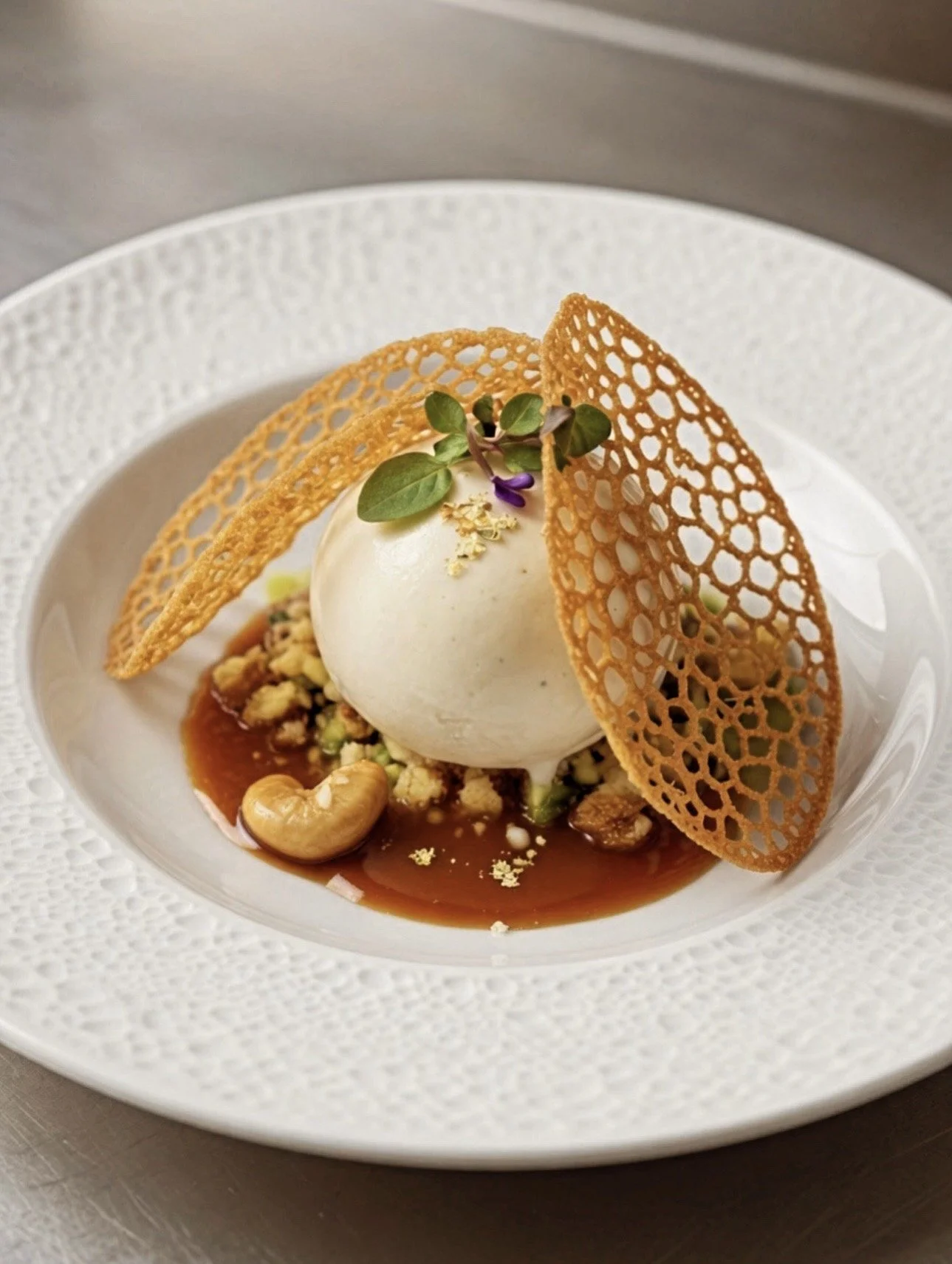
NUTTY VANILLA PARFAIT
Olive Oil Gel • Thickened Maple Syrup • Fleur de Sel
A vegan dessert built on restraint, texture tension, and controlled sweetness — where fat, salt, and aromatics replace sugar-heavy excess.
There’s a stubborn myth that vegan desserts are somehow lesser — less rich, less luxurious, less serious. One bite of the right one and that idea quietly disappears.
Look at these plates. The first features a flawless sphere of nutty vanilla olive oil gel resting in thickened maple syrup with fleur de sel. Golden lace tuiles arch overhead like stained glass, a toasted cashew nestled below with crumble and a delicate spray of herbs and flowers. It doesn’t announce itself as vegan. It simply looks like something you’d remember from a great restaurant weeks later.
The second is elegant architecture: crisp caramelized layers stacked with soft vanilla cream, glossy fruit, and crowned with deep purple microgreens. Playful yet precise.
These aren’t imitations of dairy and eggs. They stand on their own — often clearer, brighter, and more interesting. Without butter and cream dominating, flavors speak louder: toasted nuts taste warmer, olive oil adds gentle peppery depth, cashew cream brings silk without weight, citrus cuts sharper, chocolate tastes more honest.
The textures demand real craft. Cloud-light aquafaba meringues, olive oil gels that melt differently, tuiles that shatter like glass. Nothing is accidental. Every element earns its place.
This way of cooking forces restraint, and that’s its quiet power. You can’t hide behind fat or sugar, so balance becomes everything — a swipe of cream against poached pear, a caramel shard and pinch of salt on chocolate mousse, flakes of sea salt on maple. Small details that make the plate sing.
Presentation matches the philosophy: clean white plates, negative space, one dramatic tuile or a single herb sprig. Restraint makes it feel more special, not less.
Making these well is harder than the traditional route. It requires deeper understanding of structure and technique. But the result feels more deliberate, more intentional, and more honest.
In the end, a great dessert is about contrast, texture, temperature, and balance. These plant-based versions don’t need to prove anything. They arrive on the plate and speak for themselves.
And once you’ve had one done right, you stop thinking “vegan dessert.”
You just want another bite.
